The resistance of the filament of an electric bulb changes with temperature. If an electric bulb rated $220\, volt$ and $100\, watt$ is connected $(220 \times 0.8)$ $volt$ sources, then the actual power would be
Diffcult
Download our app for free and get started
(d) ${P_1} = \frac{{{{(220)}^2}}}{{{R_1}}}$ and ${P_2} = \frac{{{{(220 \times 0.8)}^2}}}{{{R_2}}}$
$\frac{{{P_2}}}{{{P_1}}} = \frac{{{{(220 \times 0.8)}^2}}}{{{{(220)}^2}}} \times \frac{{{R_1}}}{{{R_2}}}$ $⇒$ $\frac{{{P_2}}}{{{P_1}}} = {(0.8)^2} \times \frac{{{R_1}}}{{{R_2}}}$ Here $R_2 < R_1$
(because voltage decreases from $220 V ⇒ 220 × 0.8 \,V$
It means heat produced $⇒$ decreases)
So $\frac{{{R_1}}}{{{R_2}}} > 1$ $⇒$ ${P_2} > {(0.8)^2}{P_1}$ $⇒$ ${P_2} > {(0.8)^2} \times 100\,W$
Also $\frac{{{P_2}}}{{{P_1}}} = \frac{{(220 \times 0.8){i_2}}}{{220\,{i_1}}},$ Since ${i_2} < {i_1}$ (we expect)
So $\frac{{{P_2}}}{{{P_1}}} < 0.8$ $⇒$ ${P_2} < (100 \times 0.8)$
Hence the actual power would be between $100 \times {(0.8)^2}\,W$ and $(100 × 0.8)\, W$
$\frac{{{P_2}}}{{{P_1}}} = \frac{{{{(220 \times 0.8)}^2}}}{{{{(220)}^2}}} \times \frac{{{R_1}}}{{{R_2}}}$ $⇒$ $\frac{{{P_2}}}{{{P_1}}} = {(0.8)^2} \times \frac{{{R_1}}}{{{R_2}}}$ Here $R_2 < R_1$
(because voltage decreases from $220 V ⇒ 220 × 0.8 \,V$
It means heat produced $⇒$ decreases)
So $\frac{{{R_1}}}{{{R_2}}} > 1$ $⇒$ ${P_2} > {(0.8)^2}{P_1}$ $⇒$ ${P_2} > {(0.8)^2} \times 100\,W$
Also $\frac{{{P_2}}}{{{P_1}}} = \frac{{(220 \times 0.8){i_2}}}{{220\,{i_1}}},$ Since ${i_2} < {i_1}$ (we expect)
So $\frac{{{P_2}}}{{{P_1}}} < 0.8$ $⇒$ ${P_2} < (100 \times 0.8)$
Hence the actual power would be between $100 \times {(0.8)^2}\,W$ and $(100 × 0.8)\, W$

Download our appand get started for free
Experience the future of education. Simply download our apps or reach out to us for more information. Let's shape the future of learning together!No signup needed.*
Similar Questions
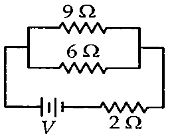
- 1If power dissipated in the $9 \,\Omega$ resistor in the circuit shown is $36\,W$, the potential difference across the $2 \,\Omega$ resistor is .......... $V$View Solution
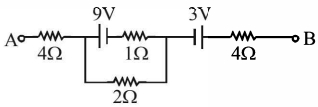
- 2In the circuit shown in figure potential difference between points A and $B$ is $16\,V$. the current passing through $2 \Omega$ resistance will be $...........\,A$View Solution
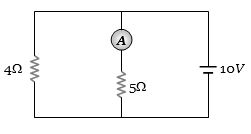
- 3In the circuit, the reading of the ammeter is ................. $A$ (assume internal resistance of the battery be zero)View Solution
- 4The Kirchhooff's first law $\left(\sum i=0\right)$ and second law ( $\left.\sum i R=\sum E\right)$, where the symbols have their usual meanings, are respectively based onView Solution
- 5$A$ wire of length $L$ and $3$ identical cells of negligible internal resistances are connected in series. Due to the current, the temperature of the wire is raised by $\Delta T$ in time $t. N$ number of similar cells is now connected in series with a wire of the same material and cross section but of length $2L$. The temperature of the wire is raised by the same amount $\Delta T$ in the same time $t$. The value of $N$ is :View Solution
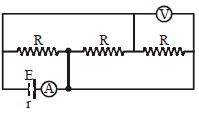
- 6In the following circuit diagram, $E = 4\,V, r = 1\,\Omega$ and $R = 45\, \Omega$, then reading of the ammeter $A$ will beView Solution
- 7View SolutionThe example for non-ohmic resistance is
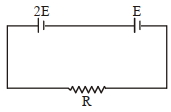
- 8Two cells of emf $2\, E$ and $E$ with internal resistance $r _{1}$ and $r _{2}$ respectively are connected in series to an external resistor $R$ (see $figure$). The value of $R ,$ at which the potential difference across the terminals of the first cell becomes zero isView Solution
- 9The $V-i$ graph for a conductor makes an angle $\theta $ with $V-$ axis. Here $ V$ denotes the voltage and $i$ denotes current. The resistance of conductor is given byView Solution
- 10The length of a wire of a potentiometer is $100\, cm$, and the $emf$ of its standard cell is $E\,volt$. It is employed to measure the $e.m.f$ of a battery whose internal resistance is $0.5 \,\Omega$. If the balance point is obtained at $l = 30\, cm$ from the positive end, the $e.m.f.$ of the battery isView Solution
where $i$ is the current in the potentiometer