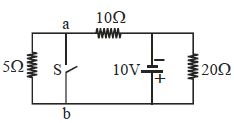
The resistance ofeach arm of the Wheatstone's bridge is $10\; ohm$. A resistance of $10 \;ohm$ is connected in series with a galvanometer then the equivalent resistance across the battery will be
AIPMT 2001, Easy


Download our appand get started for free
Experience the future of education. Simply download our apps or reach out to us for more information. Let's shape the future of learning together!No signup needed.*
Similar Questions
- 1An electric fan and a heater are marked as $100\, watt$, $220\, volt$ and $1000\, watt$, $220\, volt$ respectively. The resistance of the heater isView Solution
- 2If two bulbs of wattage $25$ and $30$, each rated at $220\, volts$, are connected in series with a $440$ $volt$ supply, which bulb will fuseView Solution
- 3Two solid conductors are made up of same material, have same length and same resistance. One of them has a circular cross section of area $A_{1}$ and the other one has a square cross section of area $A_{2}$. The ratio $\frac{A _{1}}{A _{2}}$ isView Solution
- 4A bulb has specification of one kilowatt and $250\, volts$, the resistance of bulb is .................. $\Omega$View Solution
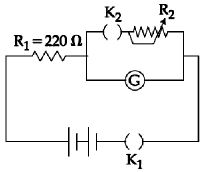
- 5The galvanometer deflection, when key $K_1$ is closed but $K_2$ is open, equals $\theta_0$ (see figure). On closing $K_2$ also and adjusting $R_2$ to $5\,\Omega $ , the deflection in galvanometer becomes $\frac{{\theta _0}}{5}$. The resistance of the galvanometer is, then, given by [Neglect the internal resistance of battery]: .................. $\Omega$View Solution
- 6A potentiometer has uniform potential gradient across it. Two cells connected in series $(i)$ to support each other and $(ii)$ to oppose each other are balanced over $6\,m$ and $2\,m$ respectively on the potentiometer wire. The $e.m.f.$’s of the cells are in the ratio ofView Solution
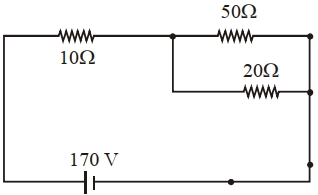
- 7The voltage across the $10\, \Omega$ resistor in the given circuit is $x$ volt.View Solution
The value of $'x'$ to the nearest integer is..........
- 8Four wires of the same diameter are connected in turn between two points, maintained at a constant potential difference. Their resistivities are; $\rho $ and $L$ (wire $1$ )., $1.2\,\rho $ and $1.2\,L$ (wire $2$ ), $0.9\,\rho $ and $0.9\,L$ (wire $3$ ) and $\rho $ and $1.5\,L$ (wire $4$ ). Rank the wires according to the rates at which energy is dissipated as heat, greatest firstView Solution
- 9The energy consumed in $1\, Kwatt$ electric heater in $30$ seconds will beView Solution
- 10In the circuit shown below, the current that flows from $a$ to $b$ when the switch $S$ is closed ............... $A$View Solution