The total energy of a particle executing S.H.M. is proportional to
Easy


Download our appand get started for free
Experience the future of education. Simply download our apps or reach out to us for more information. Let's shape the future of learning together!No signup needed.*
Similar Questions
- 1Two masses $m_1$ and $m_2$ are suspended together by a massless spring of constant $K$. When the masses are in equilibrium, $m_1$ is removed without disturbing the system. The amplitude of oscillations isView Solution

- 2A simple harmonic oscillator has an amplitude a and time period $T$. The time required by it to travel from $x = a$ to $x = \frac{a }{2}$ isView Solution
- 3A block of mass $200\, g$ executing $SHM$ under the influence of a spring of spring constant $K=90\, N\,m^{-1}$ and a damping constant $b=40\, g\,s^{-1}$. The time elapsed for its amplitude to drop to half of its initial value is ...... $s$ (Given $ln\,\frac{1}{2} = -0.693$)View Solution
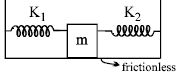
- 4Two springs with negligible masses and force constant of $K_1 = 200\, Nm^{-1}$ and $K_2 = 160\, Nm^{-1}$ are attached to the block of mass $m = 10\, kg$ as shown in the figure. Initially the block is at rest, at the equilibrium position in which both springs are neither stretched nor compressed. At time $t = 0,$ a sharp impulse of $50\, Ns$ is given to the block with a hammer.View Solution
- 5The displacement of a particle is given at time $t$, by:$x=A \sin (-2 \omega t)+B \sin ^2 \omega t \quad$ Then,View Solution
- 6Match $List - I$ with $List - II$View Solution
Choose the correct answer from the options given below

- 7If the time period of a two meter long simple pendulum is $2\, s$, the acceleration due to gravity at the place where pendulum is executing $S.H.M.$ isView Solution
- 8A particle executes linear simple harmonic motion with an ampilitude of $3\,cm$ . When the particle is at $2\,cm$ from the mean position , the magnitude of its velocity is equal to that of its acceleration. Then its time period in seconds isView Solution
- 9A particle of mass $200 \,gm$ executes $S.H.M.$ The restoring force is provided by a spring of force constant $80 \,N / m$. The time period of oscillations is .... $\sec$View Solution
- 10Amplitude of a wave is represented by $A = \frac{c}{{a + b - c}}$ Then resonance will occur whenView Solution