MCQ
The translation distances (dx, dy) is called as:
  • A
    Translation vector.
  • B
    Shift vector.
  • C
    Both A and B.
  • D
    Neither A nor B.

Answer

  1. Both A and B.

Explanation:

Basic theory, (dx, dy) is called as transitional or shift vector.

Need a full question paper?

Generate a complete, print-ready paper with questions like this in minutes — across 16+ boards, with answer keys.
Start Generating Free

Similar questions

The body will speed up if ___________.
The co-ordinates of a particle moving in $x-y$ plane are given by :  $\mathrm{x}=2+4 \mathrm{t}, \mathrm{y}=3 \mathrm{t}+8 \mathrm{t}^2 .$ The motion of the particle is :
The initial temperature of a body is $80°C$ . If its temperature falls to $64°C$ in $5$ minutes and in $10$ minutes to $52°C$ then the temperature of surrounding will be ...... $^oC$
Which of the following expressions represent simple harmonic motion
A projectile is thrown with some initial velocity at an angle $\alpha$ to the horizontal. Its velocity when it is at the highest point is $(2 / 5)^{1 / 2}$ times the velocity when it is at height half of the maximum height. Find the angle of projection $\alpha$ with the horizontal.
A simple pendulum is suspended from the roof of a trolley which moves in a horizontal direction with an acceleration $a$, then the time period is given by $T = 2\pi \sqrt {\frac{l}{{g'}}} $, where $g'$ is equal to
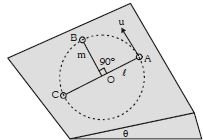
A small sphere of mass $m$ is suspended by a light and inextensible string of length $l$ from a point $O$ fixed on a smooth inclined plane of inclination $\theta $ with the horizontal. The sphere is moving in a circle on the incline as shown. If the sphere has a velocity $u$ at the top most position $A$ . Then,
An object is moving with variable speed, then
A particle is moving on a circular path with constant speed, then its acceleration will be
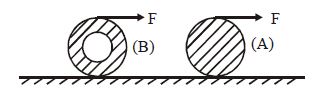
Disc $A$ and disc $B$ with a hole have equal mass and radius and a string is wrapped around them as shown. Equal force $F$ is applied on the string of each body. Friction is sufficient for rolling. After time $t$ velocity of $A$ is $v_A$ and that of $B$ is $v_B$ and kinetic energy $k_A$ & $k_B$ , then