MCQ
The unit of potential energy is
  • A
    $gm\;(cm/{\sec ^2})$
  • $gm\;{(cm/\sec )^2}$
  • C
    $gm\;(c{m^2}/\sec )$
  • D
    $gm\;(cm/\sec )$

Answer

Correct option: B.
$gm\;{(cm/\sec )^2}$
b
(b) Potential energy $ = mgh = g\left( {\frac{{cm}}{{{{\sec }^2}}}} \right)cm = g{\left( {\frac{{cm}}{{\sec }}} \right)^2}$

Need a full question paper?

Generate a complete, print-ready paper with questions like this in minutes — across 16+ boards, with answer keys.
Start Generating Free

Similar questions

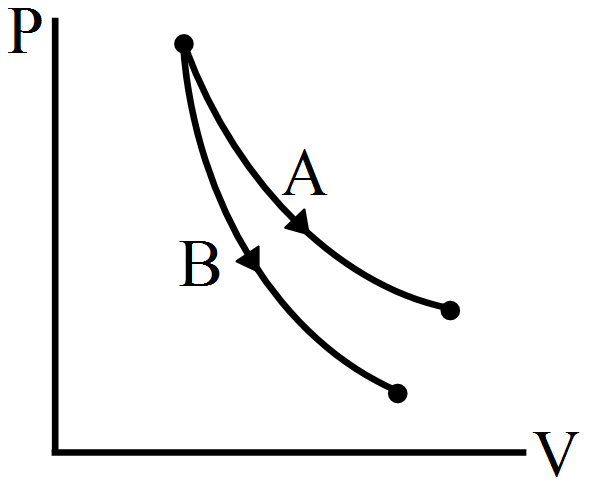
Consider the processes A and B shown in the figure. It is possible that:

  1. Both the processes are isothermal.
  2. Both the processes are adiabatic.
  3. A is isothermal and B is adiabatic.
  4. A is adiabatic and B is isothermal.
For a thermodynamic process $\delta Q = -50$ $calorie$ and $W = -20$ $calorie$ . If the initial internal energy is $-30$ $calorie$ then final internal energy will be ....... $calorie$
If a ball is thrown vertically upwards with speed $u$, the distance covered during the last $t$ seconds of its ascent is
If we use permittivity $ \varepsilon $, resistance $R$, gravitational constant $G$ and voltage $V$ as fundamental physical quantities, then
A tuning fork sounded together with a tuning fork of frequency $256$ emits two beats. On loading the tuning fork of frequency $256,$ the number of beats heard are $1$ per second. The frequency of tuning fork is
The ratio of the radii of gyration of a circular disc to that of a circular ring, each of same mass and radius, around their respective axes is
A spherically symmetric gravitational system of particles has a mass density

$\rho=\left\{\begin{array}{l}\rho_0 \text { for } r \leq R \\ 0 \text { for } r>R\end{array}\right.$

where $\rho_0$ is a constant. A test mass can undergo circular motion under the influence of the gravitational field of particles. Its speed $V$ as a function of distance $\mathrm{r}(0<\mathrm{r}<\infty)$ from the centre of the system is represented by
Streamline flow is more likely for liquids with:
  1. High density.
  2. High viscosity.
  3. Low density.
  4. Low viscosity.
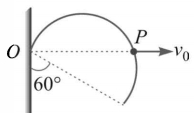
A thin but rigid semicircular wire frame of radius $r$ is hinged at $O$ and can rotate in its own vertical plane. A smooth peg $P$ starts from $O$ and moves horizontally with constant speed $v_0$, lifting the frame upward as shown in figure.Find the angular velocity $\omega$ of the frame when its diameter makes an angle of $60^{\circ}$ with the vertical :
A fireman of mass $60\, kg$ slides down a pole. He is pressing the pole with a force of $600 \,N$. The coefficient of friction between the hands and the pole is $0.5$, with what acceleration will the fireman slide down ........ $m/s^2$