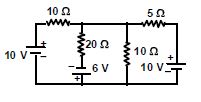
The value of current through the $20\,\Omega $ resistor is ............ $amp$
Medium
Download our app for free and get started
$\frac{x-10}{10}+\frac{x+6}{20}+\frac{x}{10}+\frac{x-10}{5}=0$
$\Rightarrow \mathrm{x}=6 \mathrm{\,V}$
$\therefore \mathrm{I}_{20 \Omega}=\frac{6+6}{20}=0.6 \mathrm{\,Amp}$

Download our appand get started for free
Experience the future of education. Simply download our apps or reach out to us for more information. Let's shape the future of learning together!No signup needed.*
Similar Questions
- 1Two wires $A$ and $B$ of the same material, having radii in the ratio $1: 2$ carry currents in the ratio $4: 1$. The ratio of drift speed of electrons in $A$ and $B$ isView Solution
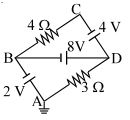
- 2The figure shows a network of resistances in which the point $A$ is earthed. The current through the $3\,\Omega$ resistor isView Solution
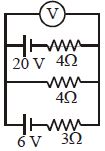
- 3What will be reading of voltmeter ................. $V$View Solution
- 4The potential gradient along the length of a uniform wire is $10\,volt/metre$. $B$ and $C$ are the two points at $30\,cm$ and $60\,cm$ point on a meter scale fitted along the wire. The potential difference between $B$ and $C$ will be ............. $volt$View Solution
- 5If $400\; \Omega$ of resistance is made by adding four $100\; \Omega$ resistance of tolerance $5 \%$ then the tolerance of the combination is .....$\%$View Solution
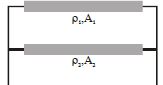
- 6Two conductors of same length are connected in parallel as shown in figure. Their cross-sectional areas $A_1$ and $A_2$ and their resistivities are ${\rho _1}$ and ${\rho _2}$ respectively. The equivalent resistivity of this combination isView Solution
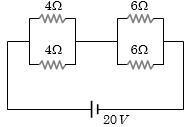
- 7Four resistances are connected in a circuit in the given figure. The electric current flowing through $4\, ohm$ and $6\, ohm$ resistance is respectivelyView Solution
- 8View SolutionAssertion : Long distance power transmission is done at high voltage.
Reason : At high voltage supply power losses are less.
- 9A cylindrical conductor has uniform cross-section. Resistivity of its material increase linearly from left end to right end. If a constant current is flowing through it and at a section distance $x$ from left end, magnitude of electric field intensity is $E$, which of the following graphs is correctView Solution
- 10A $10\, m$ long wire of $20\,\Omega$ resistance is connected with a battery of $3\, volt$ $e.m.f.$ (negligible internal resistance) and a $10 \,\Omega$ resistance is joined to it is series. Potential gradient along wire in volt per meter isView Solution