MCQ
The value of $\int\limits_0^2 {\frac{{dx}}{{{{(1 - x)}^2}}}} $ is
  • A
    $-2$
  • B
    $0$
  • C
    $15$
  • indeterminate

Answer

Correct option: D.
indeterminate
d
$\int\limits_0^2 {\frac{{dx}}{{{{(1 - x)}^2}}}} $ $= \int\limits_0^{{1^ - }} {\frac{{dx}}{{{{(1 - x)}^2}}}} \,\, + \,\,\int\limits_{{1^ + }}^2 {\frac{{dx}}{{{{(1 - x)}^2}}}} \,$

$= \left. {\frac{1}{{1 - x}}} \right]_0^{{1^ - }}\,\, + \,\,\left. {\frac{1}{{1 - x}}} \right]_{{1^ + }}^2$

$= (\infty - 1) + (-1) - (- \infty ) \Rightarrow$ indeterminant

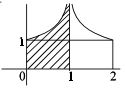
Note that the shaded area is divergent 
Need a full question paper?

Generate a complete, print-ready paper with questions like this in minutes — across 16+ boards, with answer keys.
Start Generating Free

Similar questions

If $|A| = 2,$ where $A$ is a square matrix of order $4$, then value of $|AdjAdj(2A)|$ is (where $Adj(A)$ denotes adjoint of matrix $A$)-
$\int_0^{\pi /2} {{{\sin }^4}x{{\cos }^6}x\,dx} $ equals
The lines $\frac{x-2}{2}=\frac{y}{-2}=\frac{z-7}{16}$ and $\frac{x+3}{4}=\frac{y+2}{3}=\frac{z+2}{1}$ intersect at the point $P$. If the distance of $P$ from the line $\frac{x+1}{2}=\frac{y-1}{3}=\frac{z-1}{1}$ is $l$, then $14 l^2$ is equal to.................
An are $P Q$ of a circle subtends a right angle at its centre $O$. The mid point of the arc $P Q$ is $R$. If $\overline{O P}=\vec{u}, \overline{O R}=\vec{v}$ and $\overrightarrow{O Q}=\alpha \vec{u}+\beta \vec{v}$, then $\alpha, \beta^2$ are the roots of the equation
The shaded region in the given figure is a graph of $.....$
If $\,\left| \begin{array}{l}\,6i\,\,\,\,\, - 3i\,\,\,\,\,\,\,\,\,1\\\,\,4\,\,\,\,\,\,\,\,\,3i\,\,\,\,\,\, - 1\\\,20\,\,\,\,\,\,\,\,3\,\,\,\,\,\,\,\,\,\,i\end{array} \right|\,$=$x + iy$, then $(x, y)$ is
The value of the integral $\int_{ - \pi }^\pi {\sin mx\sin nx\,dx} $ for $m \ne n$ $(m,\,\,n \in I),$ is
A function $f$ is defined as follows,

$f(x) =$ $\left\{ {\begin{array}{*{20}{c}}  {\sin \,x}&{if\,\,\,x\,\, \leqslant \,\,c} \\   {ax\, + \,b}&{if\,\,\,x\,\, > \,\,c} \end{array}} \right.$ where $c$ is a known quantity.

If $f$ is derivable at $x = c$ , then the values of $'a'$ $and$ $'b’$ are _____ $and$______ respectively

Using the principal values of the inverse trigonometric functions the sum of the maximum and the minimum values of $16\left(\left(\sec ^{-1} x\right)^2+\left(\operatorname{cosec}^{-1} x\right)^2\right)$ is :
$\mathop {\lim }\limits_{x \to 0} {\left( {\frac{{1 + 5{x^2}}}{{1 + 3{x^2}}}} \right)^{1/{x^2}}} = $