- AThe energy necessary to emit electrons from metal surface is 2eV
- BThe energy of electrons emitted from metallic surface is 2eV
- CThe value of photoelectric current is 2eV
- DThe value of threshold frequency is 2eV
Explanation:
By definition the work function is the minimum energy (in electron volts) needed to remove an electron from a solid to a point immediately outside the solid surface (or energy needed to move an electron from the Fermi level into vacuum).
Hence, if the work function of cesium metal is 2ev, it means that the energy necessary to emit electrons from metal surface is 2eV.
Generate a complete, print-ready paper with questions like this in minutes — across 16+ boards, with answer keys.
When a proton is accelerated with 1 volt potential difference, then its kinetic energy is
|
(a) |
(b) 1840 eV |
(c) 1 eV |
(d) 1840 c2 eV |
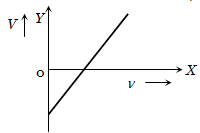
The stopping potential V for photoelectric emission from a metal surface is plotted along Y-axis and frequency n of incident light along X-axis. A straight line is obtained as shown. Planck's constant is given by

|
(a) Slope of the line |
|
(b) Product of slope on the line and charge on the electron |
|
(c) Product of intercept along Y-axis and mass of the electron |
|
(d) Product of Slope and mass of electron |
Angle of prism is A and its one surface is silvered. Light rays falling at an angle of incidence 2A on first surface return back through the same path after suffering reflection at second silvered surface. Refractive index of the material of prism is
|
(a) 2 sin A |
(b) 2 cos A |
(c) |
(d) tan A |
5 amperes of current is passed through a metallic conductor. The charge flowing in one minute in coulombs will be
|
(a) 5 |
(b) 12 |
(c) 1/12 |
(d) 300 |
Statement-II: For heavy nuclei, binding energy per nucleon increases with increasing Z. while for light nuclei it decreases with increasing Z.
Curies law can be written as
|
(a) x ∝ (T - |
(b) x ∝ |
(c) x ∝ |
(d) x ∝ T |
Let V and H be the vertical and horizontal components of earth's magnetic field at any point on earth. Near the north pole
|
(a) V >> H |
(b) V << H |
(c) V = H |
(d) V = H = 0 |