MCQ
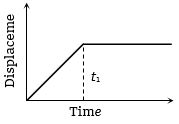
The $x - t$ graph shown in figure represents
  • A
    Constant velocity
  • B
    Velocity of the body is continuously changing
  • C
    Instantaneous velocity
  • The body travels with constant speed upto time ${t_1}$ and then stops

Answer

Correct option: D.
The body travels with constant speed upto time ${t_1}$ and then stops
d
(d)Up to time ${t_1}$ slope of the graph is constant and after ${t_1}$slope is zero i.e. the body travel with constant speed up to time ${t_1}$ and then stops.

Need a full question paper?

Generate a complete, print-ready paper with questions like this in minutes — across 16+ boards, with answer keys.
Start Generating Free

Similar questions

Between the two stations a train accelerates uniformly at first, then moves with constant velocity and finally retards uniformly. If the ratio of the time taken be $1 : 8 : 1$ and the maximum speed attained be $60\,km/h,$ then what is the average speed over the whole journey.......$km/h$
When a capillary tube is dipped into a liquid, the liquid neither rises nor falls in the capillary.
When a body of mass $1.0\, kg$ is suspended from a certain light spring hanging vertically, its length increases by $5\, cm$. By suspending $2.0\, kg$ block to the spring and if the block is pulled through $10\, cm$ and released the maximum velocity in it in $m/s$ is : (Acceleration due to gravity $ = 10\,m/{s^2})$
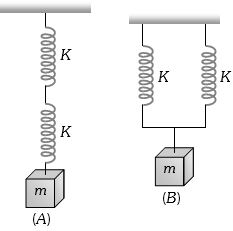
Two identical spring of constant $K$ are connected in series and parallel as shown in figure. A mass $m$ is suspended from them. The ratio of their frequencies of vertical oscillations will be
A particle executing simple harmonic motion along $Y- $axis has its motion described by the equation $y = A\sin (\omega \,t) + B$. The amplitude of the simple harmonic motion is
A tuning fork of known frequency $256\,Hz$ makes $5$ beats per second with the vibrating string of a guitar. The beat frequency decreases to $2$ beats per second when the tension in the guitar string slightly increased. The frequency of the guitar string before increasing the tension was ..... $Hz$
According to ‘Newton’s Law of cooling’, the rate of cooling of a body is proportional to the
A particle of mass $m$ describes a circle of radius $r$. The centripetal acceleration of the particle is $4/r^2$. What will be the momentum of the particle?
Parallel rays of light of intensity $I =912 \ Wm ^{-2}$ are incident on a spherical balck body kept in surroundings of temperature $300 \ K$. Take Stefan-Boltzmann constant $\sigma=5.7 \times 10^{-8} Wm ^{-2} K ^{-4}$ and assume that the energy exchange with the surroundings is only through radiation. Th final steady state temperature of the black body is close to:
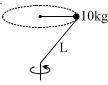
$A \,10\, kg$ ball attached to the end of a rigid massless rod of length $1\, m$ rotates at constant speed in a horizontal circle of radius $0.5\, m$ and period $1.57 \, sec$ as in fig. The force exerted by rod on the ball is ........ $N$.