Question
The Young’s modulus for steel is much more than that for rubber. For the same longitudinal strain, which one will have greater tensile stress?

Answer

$\text{Y}=\frac{\text{stress}}{\text{strain}}$ As per question longitudinal strain for rubber and steel are equal. $\therefore\text{Y}\propto\text{stress}$ $\therefore\frac{\text{Y}_\text{steel}}{\text{Y}_\text{Rubber}}=\frac{\text{(stress})_\text{steel}}{\text{(stress})_\text{Rubber}}\text{ As the Y}_\text{steel}>\text{Y}_\text{Rubber}$ $\therefore\frac{\text{Y}_\text{steel}}{\text{Y}_\text{Rubber}}>1$ $\therefore\text{(stress})_\text{steel}$ is larger than $(Stress)_{Rubber}$

Need a full question paper?

Generate a complete, print-ready paper with questions like this in minutes — across 16+ boards, with answer keys.
Start Generating Free

Similar questions

The audible frequency range of a human ear is 20Hz-20kHz. Convert this into the corresponding wavelength range. Take the speed of sound in air at ordinary temperature to be 340m/s.
An aeroplane's velocity is doubled. What happens to its momentum and kinetic energy?
The separation between a node and the next antinode in a vibrating air column is 25cm. If the speed of sound in air is 340m/s, find the frequency of vibration of the air column.
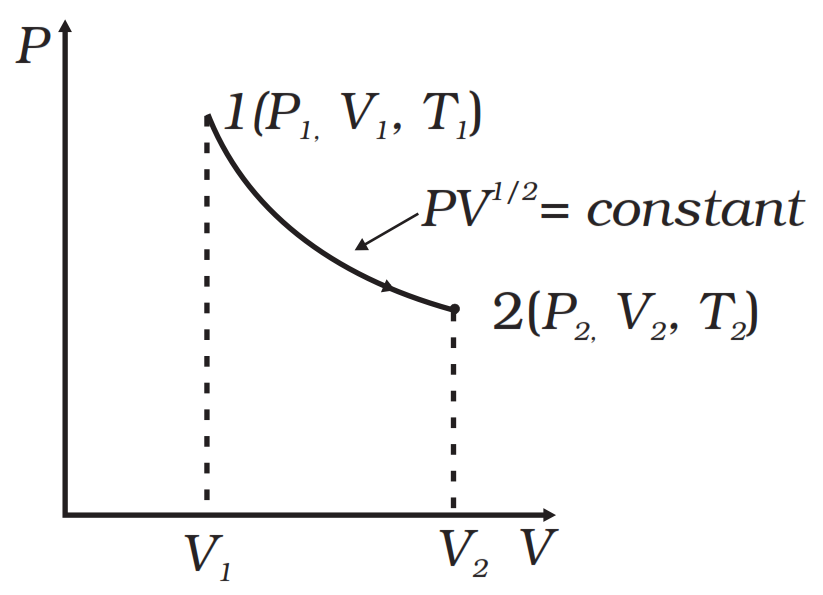
Consider a P-V diagram in which the path followed by one mole of perfect gas in a cylindrical container is shown in Fig.

Find the work done when the gas is taken from state 1 to state 2.
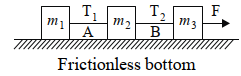
In the figure, three blocks are tied with two strings $A$ and $B . m_1=10 kg, m_2=5 kg, m_3=5 kg$. The bottom is frictionless. If $m _3$ is pulled to the right by applying a horizontal force of 50 N then calculate the tension in the strings.
Image
Explain why: A body with large reflectivity is a poor emitter.
Answer the following questions:Time period of a particle in SHM depends on the force constant k and mass m of the particle: $\text{T}=2\pi\sqrt{\frac{\text{m}}{\text{k}}}.$ A simple pendulum executes SHM approximately. Why then is the time period of a pendulum independent of the mass of the pendulum?
A 1 meter thick cement wall can withstand a pressure of $10^5 N / m ^2$. What should be the thickness of the wall at the base of a 200 m depth water of dam?
(Density of water $=10^3 kg / m ^3$ and acceleration due to gravity $=9.8 m / s ^2$ )
A cyclist speeding at 18km/ h on a level road takes a sharp circular turn of radius 3m without reducing the speed. The co-efficient of static friction between the tyres and road is 0.1. Will the cyclist slip while taking the turn? Explain.
What is the Bulk modulus for a perfect rigid body?