There are two electric bulbs of $40\, W$ and $100\, W$. Which one will be brighter when first connected in series and then in parallel,
Medium
Download our app for free and get started
(a) $\frac{{{R_1}}}{{{R_2}}} = \frac{{{P_2}}}{{{P_1}}} = \frac{{100}}{{40}} = \frac{5}{2}$. Resistance of $40\, W$ bulb is $\frac{5}{2}$ times than $100\, W$. In series, $P = {i^2}R$ and in parallel, $P = \frac{{{V^2}}}{R}$. So $40\, W$ in series and $100\, W$ in parallel will glow brighter.

Download our appand get started for free
Experience the future of education. Simply download our apps or reach out to us for more information. Let's shape the future of learning together!No signup needed.*
Similar Questions
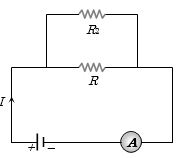
- 1If a resistance ${R_2}$ is connected in parallel with the resistance $R$ in the circuit shown, then possible value of current through $R$ and the possible value of ${R_2}$ will beView Solution
- 2View SolutionBy increasing the temperature, the specific resistance of a conductor and a semiconductor
- 3A potentiometer consists of a wire of length $4\, m$ and resistance $10\,\Omega $. It is connected to a cell of $e.m.f.$ $2\, V$. The potential difference per unit length of the wire will be ............. $V/m$View Solution
- 4Two wires $A$ and $B$ made of same material and having their lengths in the ratio $6 : 1$ are connected in series. The potential difference across the wires are $3\,V$ and $2\,V$ respectively. If $r_A$ and $r_B$ are the radii of $A$ and $B$ respectively, then $\frac{{{r_B}}}{{{r_A}}}$ isView Solution
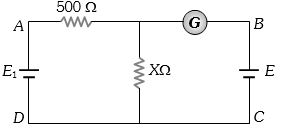
- 5In the adjoining circuit, the battery ${E_1}$ has an $e.m.f.$ of $12\,volt$ and zero internal resistance while the battery $E$ has an $e.m.f.$ of $2\,volt$. If the galvanometer $G$ reads zero, then the value of the resistance $X$ in $ohm$ isView Solution
- 6The temperature coefficient of resistance of tungsten is $4.5 \times 10^{-3}{ }^{\circ} C ^{-1}$ and that of germanium is $-5 \times 10^{-2}{ }^{\circ} C ^{-1}$. A tungsten wire of resistance $100 \,\Omega$ is connected in series with a germanium wire of resistance $R$. The value of $R$ for which the resistance of combination does not change with temperature is .......... $\Omega$View Solution
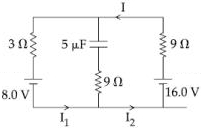
- 7The circuit shown here has two batteries of $8.0\,V$ and $16.0\,V$ and three resistors $3\,\Omega ,\,9\,\Omega $ and $9\,\Omega $ and a capacitor of $5.0\,\mu F.$View Solution
How much is the current $I$ in the circuit in steady state? ................... $A$
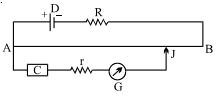
- 8In the given potentiometer circuit, the resistance of the potentiometer wire $AB$ is $R_0$. $C$ is a cell of internal resistance $r$. The galvanometer $G$ does not give zero deflection for any position of the jockey $J$. Which of the following cannot be a reason for this?View Solution
- 9A $10\, ohm$ electric heater operates on a $110\, V$ line. Calculate the rate at which it develops heat in ............... $watts$View Solution
- 10View SolutionThe reading of the ammeter as per figure shown is