There are two wires of the same length and of the same material and radii $r$ and $2r$ . The ratio of their specific resistance is
Easy


Download our appand get started for free
Experience the future of education. Simply download our apps or reach out to us for more information. Let's shape the future of learning together!No signup needed.*
Similar Questions
- 1Two wires of same metal have the same length but their cross-sections are in the ratio $3:1$. They are joined in series. The resistance of the thicker wire is $10\,\Omega $. The total resistance of the combination will be ............. $\Omega$View Solution
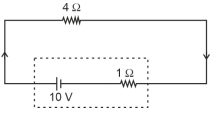
- 2The terminal voltage of the battery, whose emf is $10 \mathrm{~V}$ and internal resistance $1 \Omega$, when connected through an external resistance of $4 \Omega$ as shown in the figure is:View Solution
- 3The length of a potentiometer wire is $\ell $. A cell of emf $E$ is balanced at a length $\ell /3$ from the positive end of the wire. If the length of the wire is increased by $\ell /2$ at what distance will the same cell give a balanced pointView Solution
- 4A wire of resitance $R$ and length $L$ is cut into $5$ equal part. if these parts are joined parts are joined paralley, than result resistance will be:View Solution
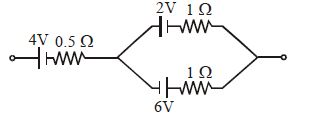
- 5Find the net emf of the three batteries shown in figure ................ $\mathrm{V}$View Solution
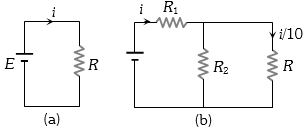
- 6Consider the circuits shown in the figure. Both the circuits are taking same current from battery but current through $R$ in the second circuit is $\frac{1}{{10}}$$^{th}$ of current through $R$ in the first circuit. If $R$ is $11$ $\Omega$, the value of $ R_1$ ................ $\Omega$View Solution
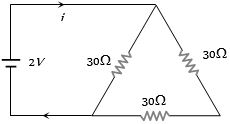
- 7View SolutionThe current in the adjoining circuit will be
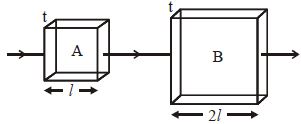
- 8Two square metal plates $A$ and $B$ are of the same thickness and material. The side of $B$ is twice that of $A$. These are connected as shown in series. If the resistances of $A$ and $B$ are denoted by $R_A$ and $R_B,$ then $(R_A/R_B)$ isView Solution
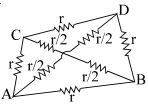
- 9The figure shows a tetrahedron, each side of which has a resistance $r$ If a battery is connected between any two points of the tetrahedron, then identify the correct statement $(s)$.View Solution
- 10View SolutionLamps used for household lighting are connected in