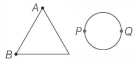
A uniform metallic wire of length $L$ is mounted in two configurations. In configuration $1$ (triangle), it is an equilateral triangle and a voltage $V$ is applied to corners $A$ and $B$. In configuration $2$ (circle), it is bent in the form of a circle and the potential $V$ is applied at diametrically opposite points $P$ and $Q$. The ratio of the power dissipated in configuration $1$ to configuration $2$ is
KVPY 2017, Advanced
Download our app for free and get started
(b)
Let $a=$ side length of equilateral triangle, $r=$ radius of circle and $x=$ resistance per unit length of wire used. Then, $L=3 a=2 \pi r$ or $a=\frac{L}{3}$ and $r=\frac{L}{2 \pi}$ Now,
Equivalent resistance across $A B$ is
$R_{A B}=(a x \| 2 a x)=\frac{a x \times 2 a x}{a x+2 a x}$
$=\frac{2 a^2 x^2}{3 a x}=\frac{2}{3} a x$
$\Rightarrow \quad R_{A B}=\frac{2}{3} \times \frac{L}{3} \times x$
Power dissipated is
$P_1=\frac{V^2}{R_{A B}}=\frac{9 V^2}{2 L x} \quad \dots(i)$
$R_{P Q}=(\pi r x \| \pi r x)=\frac{\pi r x \times \pi r x}{\pi r x+\pi r x}=\frac{\pi^2 r^2 x^2}{2 \pi r x}$
$=\frac{1}{2} \pi r x=\frac{1}{2} \pi \times \frac{L}{2 \pi} x=\frac{L x}{4}$
So, power dissipated is
$P_2=\frac{V^2}{R_{P Q}}=\frac{4 V^2}{L x}$
Ratio of power dissipated in two cases is
$\frac{P_1}{P_2}=\frac{9 V^2 / 2 L x}{4 V^2 / L x}=\frac{9}{8}$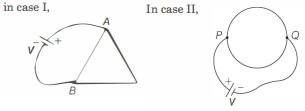

Download our appand get started for free
Experience the future of education. Simply download our apps or reach out to us for more information. Let's shape the future of learning together!No signup needed.*
Similar Questions
- 1As shown, the circuit is made of $8$ different resistors. It is found that when $R_1 = 4\,\,\Omega,$ the resistance between $A$ and $B$ is $2\,\,\Omega.$ Now replace $R_1$ by a $6\,\,\Omega$ resistor, what is the resistance between $A$ and $B$?View Solution
- 2The value of internal resistance of an ideal cell is $\Omega$View Solution
- 3$A$ current $I$ flows through a uniform wire of diameter $d$ when the mean electron drift velocity is $V$. The same current will flow through a wire of diameter $d/2$ made of the same material if the mean drift velocity of the electron is :View Solution
- 4A $6\,\,V$ battery is connected to the terminals of a $3\, m$ long uniform wire having resistance $100\,\Omega $. The difference in potential between two points on the wire separated by a distance of $50\, cm$ will be ............. $V$View Solution
- 5Electric bulb $50\, W$ - $100\, V$ glowing at full power are to be used in parallel with battery $120\, V$, $10 \,\Omega$. Maximum number of bulbs that can be connected so that they glow in full power isView Solution
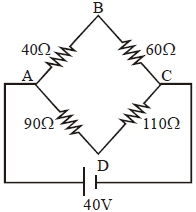
- 6Four resistances $40 \ \Omega, 60\ \Omega, 90\ \Omega$ and $110\ \Omega$ make the arms of a quadrilateral $A,B,C,D$. Across $AC$ is a battery of emf $40\, V$ and internal resistance negligible. The potential difference across $BD$ is $V$ is......View Solution
- 7$A$ uniform copper wire carries a current $i$ amperes and has $p$ carriers per meter$^3$. The length of the wire is $\lambda$ meters and its cross-section area is $s$ meter $^2$. If the charge on a carrier is $q$ coulombs, the drift velocity in $ms^{-1}$ is given byView Solution
- 8The energy consumed in $1\, Kwatt$ electric heater in $30$ seconds will beView Solution
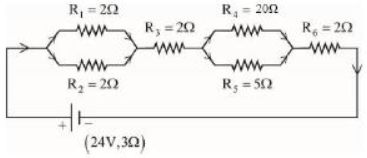
- 9As shown in the figure, a network of resistors is connected to a battery of $2\,V$ with an internal resistance of $3\,\Omega$. The currents through the resistors $R_4$ and $R_5$ are $I_4$ and $I_5$ respectively. The values of $I_4$ and $I_5$ are :View Solution
- 10A $100\, W \, bulb\, B_1$ and two $60\, W \,bulbs \,B_2$ and $B_3$, are connected to a $220\, V$ source, as shown in Figure. Now $P_1, P_2$ and $P_3$ are the output powers of the bulbs $B_1, B_2$ and $B_3$ respectively. ThenView Solution