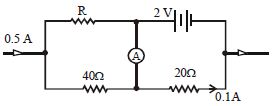
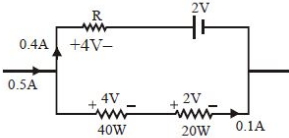
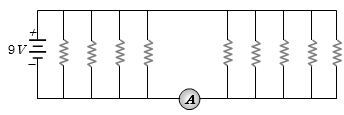
In the circuit shown in the figure, no current flows through the ideal ammeter. If the internal resistance of the cell is negligible, the value of unknown resistance $R $ is .............. $\Omega$
Medium


Download our appand get started for free
Experience the future of education. Simply download our apps or reach out to us for more information. Let's shape the future of learning together!No signup needed.*
Similar Questions
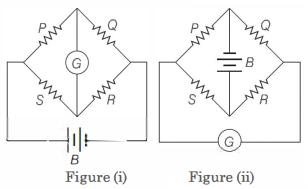
- 1Figure $(i)$ below shows a Wheatstone's bridge in which $P, Q, R$ and $S$ are fixed resistances, $G$ is a galvanometer and $B$ is a battery. For this particular case, the galvanometer shows zero deflection. Now, only the positions of $B$ and $G$ are interchanged, as shown in figure $(ii)$. The new deflection of the galvanometerView Solution
- 2The thermo $e.m.f.$ of a thermo-couple is $25\,\mu V{/^o}C$ at room temperature. A galvanometer of $40\, ohm$ resistance, capable of detecting current as low as ${10^{ - 5}}\,A,$ is connected with the thermocouple. The smallest temperature difference that can be detected by this system is ................ $^oC$View Solution
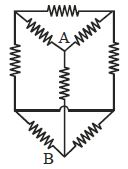
- 3Effective resistance between points $A$ and $B$ for following network is (each branch of resistance is $R$)View Solution
- 4A dry cell has an $e.m.f.$ of $1.5\, V$ and an internal resistance of $0.05\,\Omega $. The maximum current obtainable from this cell for a very short time interval is ................... $A$View Solution
- 5The internal resistance of a primary cell is $4\, ohm$. It generates a current of $0.2\, amp$ in an external resistance of $21\, ohm$. The rate at which chemical energy is consumed in providing the current is .............. $J/s$View Solution
- 6If each resistance in the figure is of $9\,\Omega$ then reading of ammeter is ............ $A$View Solution
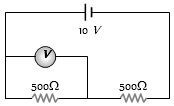
- 7A voltmeter of resistance $1000\,\Omega$ is connected across a resistance of $500\, \Omega$ in the given circuit. What will be the reading of voltmeter .............. $V$View Solution
- 8A resistor develops $500\, J$ of thermal energy in $20 \,s$ when a current of $1.5\, A$ is passed through it. If the current is increased from $1.5 \,A$ to $3\, A$ what will be the energy (in $J$) developed in $20\, s$.View Solution
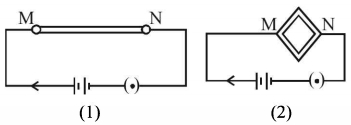
- 9A wire is connected to a battery between the point $M$ and $N$ as shown in the figure $(1)$. The same wire is bent in the form of a square and then connected to the battery between the points $M$ and $N$ as shown in the figure $(2)$. Which of the following quantities increases?View Solution
- 10What amount of heat will be generated in a coil of resistance $R$ due to a charge $q$ passing through it if the current in the coil decreases to zero uniformly during a time interval $\Delta t$View Solution