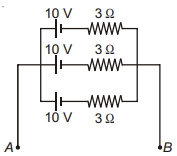
Three identical cells are connected in parallel across $A B$. Net emf across $A B$ is .......... $V$
Medium


Download our appand get started for free
Experience the future of education. Simply download our apps or reach out to us for more information. Let's shape the future of learning together!No signup needed.*
Similar Questions
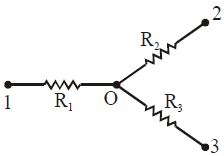
- 1.............. $A$ the current flowing through the resistance $R_2$ of the circuit shown in fig if the resistance are equal to $R_1 = 20\ \Omega, R_2 = 30 \ \Omega$ and $R_3 = 60 \ \Omega$ and potentials of points $1, 2$ and $3$ are equal to $V_1= 20\, V,$ $V_2 = 30\ V$ and $V_3 = 60\ V$View Solution
- 2Two wires each of radius of cross section $r$ but of different materials are connected together end to end (in series). If the densities of charge carriers in the two wires are in the ratio $1 : 4$, the drift velocity of electrons in the two wires will be in the ratio:View Solution
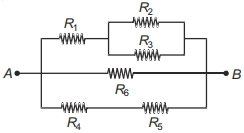
- 3View SolutionConsider the combination of resistors as shown in figure and pick out the correct statement
- 4View SolutionIn the experiment of potentiometer, at balance, there is no current in the
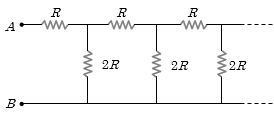
- 5An infinite ladder network is arranged with resistances $R$ and $2 R$ as shown. The effective resistance between terminals $A$ and $B$ isView Solution
- 6View SolutionThe material of fuse wire should have
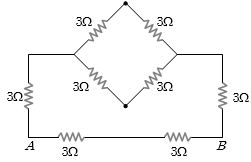
- 7Equivalent resistance between $A$ and $B$ will be ............ $ohm$View Solution
- 8Five identical cells each of internal resistance $1\, \Omega$ and $emf \;5\, {V}$ are connected in series and in parallel with an external resistance $'R'.$ For what value of $'R',$ current in series and parallel combination will remain the same ? (in $\Omega$)View Solution
- 9An infinite line charge of uniform electric charge density i. lies along the axis of an electrically conducting infinite cylindrical shell of radius $R$. At time $t=0$, the space inside the cylinder is filled with a material of permittivity $\varepsilon$ and electrical conductivity $\sigma$. The electrical conduction in the material follows Ohm's law. Which one of the following graphs best describes the subsequent variation of the magnitude of current censity $j(t)$ at any point in the material?View Solution
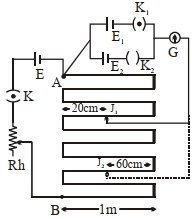
- 10In the given circuit of potentiometer, the potential difference $E$ across $AB$ ( $10\, m$ length) is larger than $E _{1}$ and $E _{2}$ as well. For key $K _{1}$ (closed), the jockey is adjusted to touch the wire at point $J_{1}$ so that there is no deflection in the galvanometer. Now the first battery $\left( E _{1}\right)$ is replaced by second battery $\left( E _{2}\right)$ for working by making $K _{1}$ open and $K _{2}$ closed. The galvanometer gives then null deflection at $J _{2}$. The value of $\frac{ E _{1}}{ E _{2}}$ is $\frac{ a }{ b },$ where $a =$ ...............View Solution