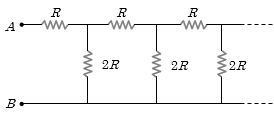
An infinite ladder network is arranged with resistances $R$ and $2 R$ as shown. The effective resistance between terminals $A$ and $B$ is
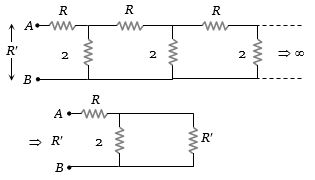
Diffcult


Download our appand get started for free
Experience the future of education. Simply download our apps or reach out to us for more information. Let's shape the future of learning together!No signup needed.*
Similar Questions
- 1The resistance of platinum wire at $0^{\circ}\,C$ is $2\,\Omega$ and $6.8\,\Omega$ at $80^{\circ} \,C$. The temperature coefficient of resistance of the wire is :View Solution
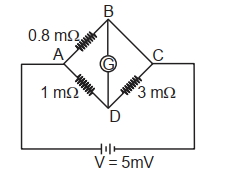
- 2To measure the temperature coefficient of resistivity $\alpha$ of a semiconductor, an electrical arrangement shown in the figure is prepared. The arm BC is made up of the semiconductor. The experiment is being conducted at $25^{\circ} \mathrm{C}$ and resistance of the semiconductor arm is $3 \mathrm{~m} \Omega$. Arm BC is cooled at a constant rate of $2^{\circ} \mathrm{C} / \mathrm{s}$. If the galvanometer $\mathrm{G}$ shows no deflection after $10 \mathrm{~s}$, then $\alpha$ is :View Solution
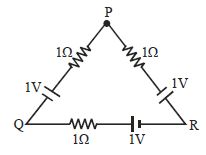
- 3In given circuit find potential difference between $P$ and $Q$ .................. $V$View Solution
- 4Four wires of equal length and of resistances $10$ $ ohms$ each are connected in the form of a square. The equivalent resistance between two opposite corners of the square is ............. $ohm$View Solution
- 5A bulb rated at ($100\,W$ - $200\,V$) is used on a $100\,V$ line. The current in the bulb isView Solution
- 6A cell of constant $e.m.f.$ first connected to a resistance ${R_1}$ and then connected to a resistance ${R_2}$. If power delivered in both cases is then the internal resistance of the cell isView Solution
- 7By a cell a current of $0.9\, A$ flows through $2\, ohm$ resistor and $0.3\,A$ through $7\, ohm$ resistor. The internal resistance of the cell is ............ $\Omega$View Solution
- 8In the experiment of $Ohm's law,$ a potential difference of $5.0\, V$ is applied across the end of a conductor of length $10.0\, cm$ and diameter of $5.00\, mm .$ The measured current in the conductor is $2.00\, A$. The maximum permissible percentage error in the resistivity of the conductor isView Solution
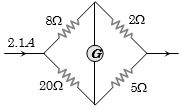
- 9In the given figure, when galvanometer shows no deflection, the current (in $A$) flowing through $5\,\Omega $ resistance will beView Solution
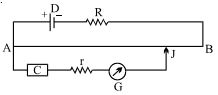
- 10In the given potentiometer circuit, the resistance of the potentiometer wire $AB$ is $R_0$. $C$ is a cell of internal resistance $r$. The galvanometer $G$ does not give zero deflection for any position of the jockey $J$. Which of the following cannot be a reason for this?View Solution