Three resistances of magnitude $2$, $3$ and $5$ $ohm$ are connected in parallel to a battery of $10\, volts$ and of negligible resistance. The potential difference across $3\,\Omega $ resistance will be ............... $volts$
Easy
Download our app for free and get started
(d) Potential difference across all resistors in parallel combination is same.

Download our appand get started for free
Experience the future of education. Simply download our apps or reach out to us for more information. Let's shape the future of learning together!No signup needed.*
Similar Questions
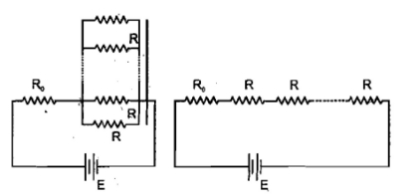
- 1In the circuit shown, $n$-identical resistors $R$ are connected in parallel $(n > 1)$ and the combination is connected in series to another resistor $R_0$. In the adjoining circuit $n$ resistors of resistance $R$ are all connected in series alongwith $R_0$. The batteries in both circuits are identical and net power dissipated in the $n$ resistors in both circuits is same. The ratio $R_0 / R$ isView Solution
- 2Two equal resistances when connected in series to a battery, consume electric power of $60\,W.$ If these resistances are now connected in parallel combination to the same battery, the electric power consumed will be .............. $W$View Solution
- 3An electrical power line, having a total resistance of $2 \Omega$, delivers $1 \,kW$ at $220\, V$. The efficiency of the transmission line is approximately $.......\%$View Solution
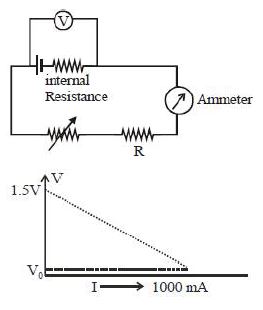
- 4To verify Ohm's law, a student connects the voltmeter across the battery as, shown in the figure. The measured voltage is plotted as a function of the current, and the following graph is obtained If $V_0$ is almost zero, identify the correct statementView Solution
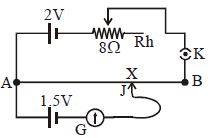
- 5In a potentiometer experiment shown here, for the position $X$ of the jockey $J,$ there occurs a null deflection in the galvanometer. Then the potential difference between points $A$ and $X$ is ................ $V$View Solution
- 6A wire $100\,cm$ long and $2.0\,mm$ diameter has a resistance of $0.7\, ohm$, the electrical resistivity of the material is ...........$ \times {10^{ - 6}}\,ohm \times m$View Solution
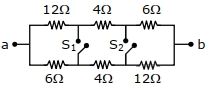
- 7In the given figure switches $S_{1}$ and $S_{2}$ are in open condition. The resistance across $a b$ when the switches $S_{1}$ and $S_{2}$ are closed is $...\,\Omega$View Solution
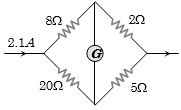
- 8In the given figure, when galvanometer shows no deflection, the current (in $A$) flowing through $5\,\Omega $ resistance will beView Solution
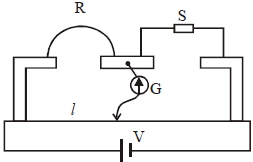
- 9In a meter bridge experiment $\mathrm{S}$ is a standard resistance. $\mathrm{R}$ is a resistance wire. It is found that balancing length is $l=25 \;\mathrm{cm} .$ If $\mathrm{R}$ is replaced by a wire of half length and half diameter that of $\mathrm{R}$ of same material, then the balancing distance $\left.l^{\prime} \text { (in } \mathrm{cm}\right)$ will now beView Solution
- 10In a circuit shown in the figure, the capacitor $C$ is initially uncharged and the key $K$ is open. In this condition, a current of $1 \mathrm{~A}$ flows through the $1 \Omega$ resistor. The key is closed at time $t=t_0$. Which of the following statement($s$) is(are) correct?View Solution
[Given: $\mathrm{e}^{-1}=0.36$ ]
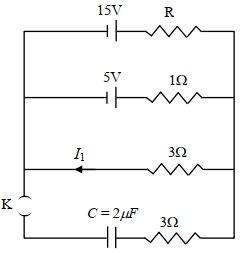
($A$) The value of the resistance $R$ is $3 \Omega$.
($B$) For $t$
($C$) At $t=t_0+7.2 \mu \mathrm{s}$, the current in the capacitor is $0.6 \mathrm{~A}$.
($D$) For $t \rightarrow \infty$, the charge on the capacitor is $12 \mu C$.