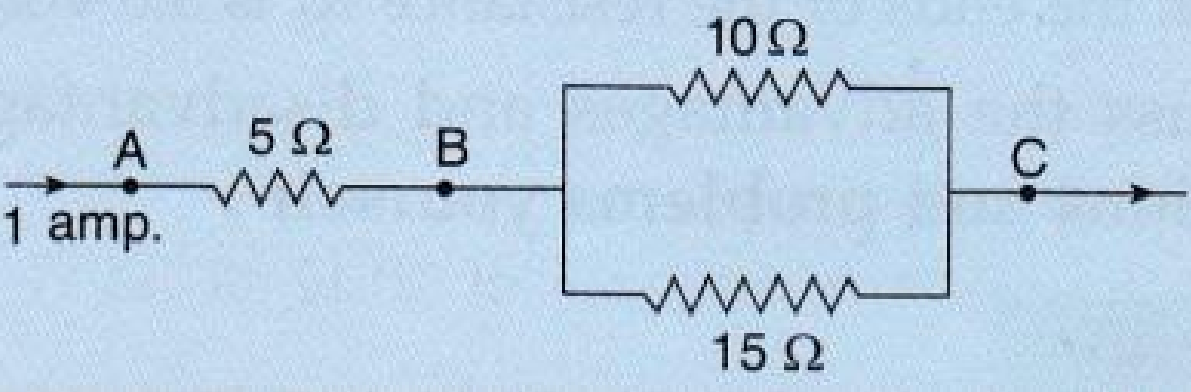
Through the resistor 5 ohm, a current of 1 ampere is flowing,
- What is the current through the other two resistors?
- What is the p.d. across AB and across AC?
- What is the total resistance?
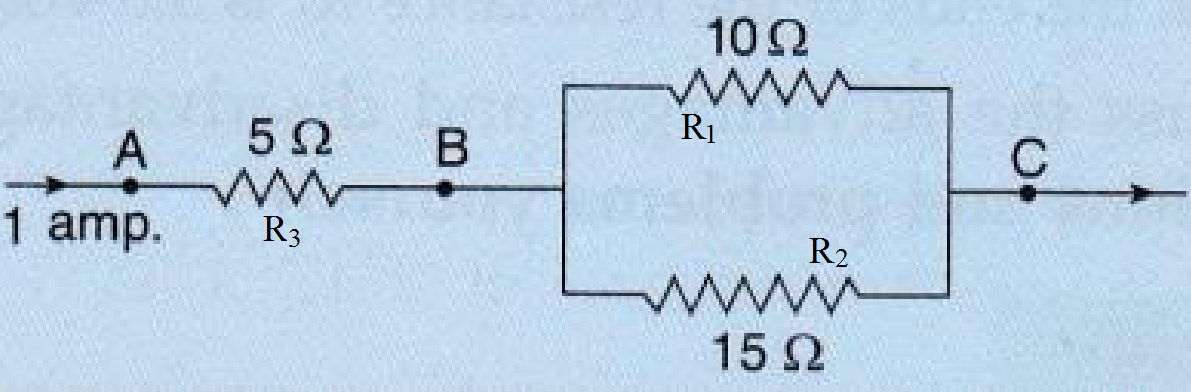
Then
$\text{I}_1=\frac{\text{IR}_2}{\text{R}_1+\text{R}_2}$
$=\frac{1\times15}{10+15}=0.6\text{A}$
$\text{I}_2=\frac{\text{IR}_2}{\text{R}_1+\text{R}_2}$
$=\frac{1\times10}{10+15}=0.4\text{A}$
Equivalent resisyance between B and C is
$\frac{1}{\text{R}'}=\frac{1}{\text{R}_1}+\frac{1}{\text{R}_2}=\frac{1}{10}+\frac{1}{15}$
$\frac{1}{\text{R}'}=\frac{5}{30}$
R' = 6 ohm
Total resistance between A and C is R = 5 + 6 = 11 ohm
p.d. across AC = IR = 1 × 11 = 11V
Generate a complete, print-ready paper with questions like this in minutes — across 16+ boards, with answer keys.
You have two lenses A and B of focal lengths +10cm and -10cm respectively. State the nature and power of each lens. Which of the two lenses will form a virtual and magnified image of an object placed 8cm from the lens? Draw a ray diagram to justify your answer.