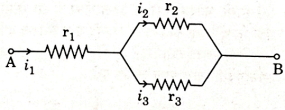
Three resistors having resistances $\mathrm{r}_{1}, \mathrm{r}_{2}$ and $\mathrm{r}_{3}$ are connected as shown in the given circuit. The ratio $\frac{i_{3}}{i_{1}}$ of currents in terms of resistances used in the circuit is :
NEET 2021, Easy
Download our app for free and get started
$I_{3}=\frac{I_{1} r_{2}}{r_{2}+r_{3}}$
$\frac{I_{3}}{I_{1}}=\frac{I_{1} r_{2}}{\left(r_{2}+r_{3}\right) I_{1}}=\frac{r_{2}}{r_{2}+r_{3}}$

Download our appand get started for free
Experience the future of education. Simply download our apps or reach out to us for more information. Let's shape the future of learning together!No signup needed.*
Similar Questions
- 1A battery consists of a variable number $n$ of identical cells (having internal resistance reach) which are connected in series. The terminals of the battery are short-circuited and the current $I$ is measured. Which of the graphs shows the correct relationship between $I$ and $n \,?$View Solution
- 2When connected across the terminals of a cell, a voltmeter measures $5\,V$ and a connected ammeter measures $10\, A$ of current. A resistance of $2\, ohms$ is connected across the terminals of the cell. The current flowing through this resistance will be ............ $A$View Solution
- 3View SolutionA potentiometer is an ideal device of measuring potential difference because
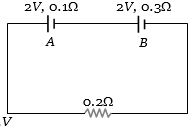
- 4The internal resistances of two cells shown are $0.1\,\Omega $ and $0.3\,\Omega $. If $R = 0.2\,\Omega $, the potential difference across the cellView Solution
- 5Three copper rods are subjected to different potential difference. Compare the drift speed of electrons through them. Assume that all $3$ are at the same temperature.View Solution
Length Diameter Potential difference $(A)$ $L$ $3d$ $V$ $(B)$ $2L$ $d$ $2V$ $(C)$ $3L$ $2d$ $2V$ - 6A $2\, volt$ battery, a $15\,\Omega $ resistor and a potentiometer of $100\, cm$ length, all are connected in series. If the resistance of potentiometer wire is $5\,\Omega $, then the potential gradient of the potentiometer wire is ............... $V/cm$View Solution
- 7Two wires $A$ and $B$ are made up of the same material and have the same mass. Wire A has radius of $2.0 \mathrm{~mm}$ and wire $B$ has radius of $4.0 \mathrm{~mm}$. The resistance of wire B is $2 \Omega$. The resistance of wire $\mathrm{A}$ is_______. $\Omega$.View Solution
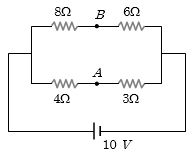
- 8The potential difference between point $A$ and $B$ is ............. $V$View Solution
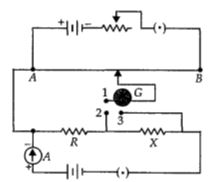
- 9A potentiometer circuit is set up as shown. The potential gradient, across the potentiometer wire, is $k$ $volt/cm$ and the ammeter, present in the circuit, reads $1.0\,\, A$ when two way key is switched off. The balance points, when the key between the terminals $(i)$ $1$ and $2$ $(ii)$ $1$ and $3,$ is plugged in, are found to be at lengths $l_1$ and $l_2$ respectively. The magnitudes, of the resistors $R$ and $X,$ in $ohms$, are then, equal, respectively, toView Solution
- 10What is the equivalent resistance of the circuit ............. $\Omega$View Solution