Two wires $A$ and $B$ are made up of the same material and have the same mass. Wire A has radius of $2.0 \mathrm{~mm}$ and wire $B$ has radius of $4.0 \mathrm{~mm}$. The resistance of wire B is $2 \Omega$. The resistance of wire $\mathrm{A}$ is_______. $\Omega$.
JEE MAIN 2024, Diffcult


Download our appand get started for free
Experience the future of education. Simply download our apps or reach out to us for more information. Let's shape the future of learning together!No signup needed.*
Similar Questions
- 1In Wheatstone's bridge $P = 9\, ohm$, $Q = 11\, ohm$, $R = 4\,ohm$ and $S = 6\,ohm$. How much resistance must be put in parallel to the resistance $S$ to balance the bridge ............... $ohm$View Solution
- 2A uniform wire of resistance $9$ $\Omega$ is cut into $3$ equal parts. They are connected in the form of equilateral triangle $ABC$. A cell of $e.m.f.$ $2\,V$ and negligible internal resistance is connected across $B$ and $C$. Potential difference across $AB$ is ............... $V$View Solution
- 3A potentiometer consists of a wire of length $4\, m$ and resistance $10 \,\Omega$. It is connected to cell of $emf$ $2\, V$. The potential difference per unit length of the wire will be ............ $V/m$View Solution
- 4View SolutionWhen a piece of aluminium wire of finite length is drawn through a series of dies to reduce its diameter to half its original value, its resistance will become ........ times
- 5A potentiometer wire of length $100\, cm$ has a resistance of $10\,\Omega $. It is connected in series with a resistance and a cell of $emf$ $2\, V$ and of negligible internal resistance. A source of $emf$ $10\,mV$ is balanced against a length of $40\, cm$ of the potentiometer wire. What is the value of external resistance ? .................. $\Omega$View Solution
- 6Two bulbs one of $200$ $\mathrm{volts},$ $60$ $\mathrm{watts}$ and the other of $200$ $\mathrm{volts},$ $100$ $\mathrm{watts}$ are connected in series to a $200$ $\mathrm{volt}$ supply. The power consumed will be ................ $\mathrm{watt}$View Solution
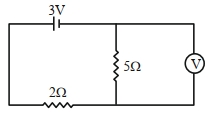
- 7As shown in the figure, the voltmeter reads $2\,V$ across $5\,\Omega$ resistor. The resistance of the voltmeter is $.......\,\Omega$.View Solution
- 8A copper wire of length $10\,m$ and radius $\left(10^{-2} / \sqrt{\pi}\right) m$ has electrical resistance of $10 \,\Omega$. The current density in the wire for an electric field strength of $10( V / m )$ is :View Solution
- 9A $25\, W$, $ 220\, V$ bulb and a $100\, W$, $220\, V$ bulb are connected in parallel across a $440\, V$ lineView Solution
- 10A cell whose e.m.f. is $2\, V$ and internal resistance is $0.1\,\Omega $, is connected with a resistance of $3.9\,\Omega $. The voltage across the cell terminal will be ................ $V$View Solution