MCQ
Three vectors $\overrightarrow a ,\,\overrightarrow b $and $\overrightarrow c $ satisfy the relation $\overrightarrow a \,.\,\overrightarrow b = 0$ and $\overrightarrow a \,.\,\overrightarrow c = 0.$ The vector $\overrightarrow a $ is parallel to
  • A
    $\overrightarrow b $
  • B
    $\overrightarrow c $
  • C
    $\overrightarrow b \,.\,\overrightarrow c $
  • $\overrightarrow b \times \overrightarrow c $

Answer

Correct option: D.
$\overrightarrow b \times \overrightarrow c $
d
(d ) $\vec a\,.\,\vec b = 0$ i.e. $\vec a $ and $\vec b$ will be perpendicular to each other

$\vec a\,.\,\vec c = 0$ i.e. $\vec a$ and $\vec c$ will be perpendicular to each other

$\vec b \times \vec c$ will be a vector perpendicular to both $\vec b$ and $\vec c$

So $\vec a$ is parallel to $\vec b \times \vec c$

Need a full question paper?

Generate a complete, print-ready paper with questions like this in minutes — across 16+ boards, with answer keys.

Start Generating Free

Similar questions

The pressure of water in a water pipe when tap is opened and closed is respectively $3 \times 10^5\,N/m^2$ and $3.5 \times 10^5\,N/m^2$ . With open tap, the velocity of water flowing is ........... $m/s$
A fan is making $600$ revolutions per minute. If after some time it makes $1200 $ revolutions per minute, then increase in its angular velocity is
A stretched rubber has
A simple pendulum with a metallic bob has a time period $T$. The bob is now immersed in a non-viscous liquid and oscillated. If the density of the liquid is $1 / 4$ that of metal, the time period of the same pendulum will be ...........
Answer the following by appropriately matching the lists based on the information given in the paragraph.

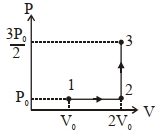
In a thermodynamics process on an ideal monatomic gas, the infinitesimal heat absorbed by the gas is given by $T \Delta X$, where $T$ is temperature of the system and $\Delta X$ is the infinitesimal change in a thermodynamic quantity $X$ of the system. For a mole of monatomic ideal gas

$X=\frac{3}{2} R \ln \left(\frac{T}{T_A}\right)+R \ln \left(\frac{V}{V_A}\right)$. Here, $R$ is gas constant, $V$ is volume of gas, $T_A$ and $V_A$ are constants.

The $List-I$ below gives some quantities involved in a process and $List-II$ gives some possible values of these quantities.

List-$I$ List-$II$
$(I)$ Work done by the system in process $1 \rightarrow 2 \rightarrow 3$ $(P)$ $\frac{1}{3} R T_0 \ln 2$
$(II)$ Change in internal energy in process $1 \rightarrow 2 \rightarrow 3$ $(Q)$ $\frac{1}{3} RT _0$
$(III)$ Heat absorbed by the system in process $1 \rightarrow 2 \rightarrow 3$ $(R)$ $R T _0$
$(IV)$ Heat absorbed by the system in process $1 \rightarrow 2$ $(S)$ $\frac{4}{3} RT _0$
  $(T)$ $\frac{1}{3} RT _0(3+\ln 2)$
  $(U)$ $\frac{5}{6} RT _0$

If the process carried out on one mole of monatomic ideal gas is as shown in figure in the PV-diagram with $P _0 V _0=\frac{1}{3} RT _0$, the correct match is,

$(1)$$I \rightarrow Q, II \rightarrow R , III \rightarrow P , IV \rightarrow U$

$(2)$ $I \rightarrow S , II \rightarrow R , III \rightarrow Q , IV \rightarrow T$

$(3)$ $I \rightarrow Q , II \rightarrow R , III \rightarrow S , IV \rightarrow U$

$(4)$ $I \rightarrow Q , II \rightarrow S , III \rightarrow R , IV \rightarrow U$

($2$) If the process on one mole of monatomic ideal gas is an shown is as shown in the $TV$-diagram with $P _0 V _0=\frac{1}{3} RT _0$, the correct match is

$(1)$ $I \rightarrow S, II \rightarrow T, III \rightarrow Q , IV \rightarrow U$

$(2)$ $I \rightarrow P , II \rightarrow R, III \rightarrow T , IV \rightarrow S$

$(3)$ $I \rightarrow P, II \rightarrow, III \rightarrow Q, IV \rightarrow T$

$(4)$ $I \rightarrow P, II \rightarrow R, III \rightarrow T, IV \rightarrow P$

Give the answer or quetion $(1)$ and $(2)$
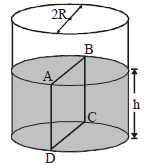
Water is filled up to a height $h$ in a beaker of radius $R$ as shown in the figure. The density of water is $\rho$, the surface tension of water is $T$ and the atmospheric pressure is $P_0$. Consider a vertical section $ABCD$ of the water column through a diameter of the beaker. The force on water on one side of this section by water on the other side of this section has magnitude
The posttion of an object moving along $x$ -axis ts given by $x=a+b t^{2}$ where $a=8.5\; \mathrm{m}, b=2.5 \;\mathrm{m} \mathrm{s}^{-2}$ and $t$ is measured in seconds. What is the velocity at $t=0\;s$ and $t=2.0 \;s$?
In a carnot engine, the temperature of reservoir is $527^{\circ} C$ and that of $\operatorname{sink}$ is $200 \; K$. If the workdone by the engine when it transfers heat from reservoir to sink is $12000 \; kJ$, the quantity of heat absorbed by the engine from reservoir is $\times 10^{6} \; J$
Consider a photon of a continuous X-ray coming from a Coolidge tube. Its energy comes from:
  1. The kinetic energy of the striking electron.
  2. The kinetic energy of the free electrons of the target.
  3. The kinetic energy of the ions of the target.
  4. An atomic transition in the target.
Solar constant $(S)$ depends upon the temperature of the Sun $(T)$ as ........