MCQ
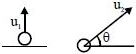
Two balls are projected from the same point simultaneously.First ball is projected vertically upwards and the second ball at an angle of projection $60^o$ to the ground level. Both the balls reach the ground simultaneously. The ratio of their velocities are
  • A
    $1:2$
  • B
    $3:2$
  • $\sqrt 3: 2$
  • D
    $2:3$

Answer

Correct option: C.
$\sqrt 3: 2$
c
time of flight $\mathrm{T}_{1}=\frac{2 \mathrm{u}_{1}}{\mathrm{g}}, \quad \mathrm{T}_{2}=\frac{2 \mathrm{u}_{2} \sin 60^{\circ}}{\mathrm{g}}$

Time of flights are equal, so $\mathrm{T}_{2}=\mathrm{T}_{1}$ $\frac{2 u \sqrt{3}}{2 g}=\frac{2 u_{1}}{g}=u_{2} \sqrt{3}=2 u_{1} \Rightarrow \frac{u_{1}}{u_{2}}=\frac{\sqrt{3}}{2}$

Need a full question paper?

Generate a complete, print-ready paper with questions like this in minutes — across 16+ boards, with answer keys.

Start Generating Free

Similar questions

Force acting on a particle moving in a straight line varies with the velocity of the particle as $F = \frac {K}{v}$ . Here $K$ is a constant. The work done by this force in time $t$ is 
An electric heater supplies heat to a system at a rate of $100\;W.$ If system performs work at a rate of $75$ Joules per second. At what rate (in $J/s$) is the internal energy increasing?
A body travels uniformly a distance of $ (13.8 \pm 0.2) m$ in a time $(4.0 \pm 0.3)\, s$. The velocity of the body within error limits is
If the tension on a wire is removed at once, then
A source of sound of frequency $256 Hz$ is moving rapidly towards a wall with a velocity of $5m/s$. The speed of sound is $330 m/s.$ If the observer is between the wall and the source, then beats per second heard will be .... $Hz$
The maximum range of a gun on horizontal terrain is $16 \,km$. If $g = \;10m/{s^2}$. What must be the muzzle velocity of the shell ......... $m/s$
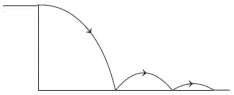
A ball is thrown horizontally from a height with a certain initial velocity at time $t=0$. The ball bounces repeatedly from the ground with the coefficient of restitution less than $1$ as shown below. Neglecting air resistance and taking the upward direction as positive, which figure qualitatively depicts the vertical component of the ball's velocity $v_y$ as a function of time $t$ ?
A air bubble of radius $1\,cm$ in water has an upward acceleration $9.8\, cm\, s ^{-2}$. The density of water is $1\, gm\, cm ^{-3}$ and water offers negligible drag force on the bubble. The mass of the bubble is$.......gm$

$\left( g =980 \,cm / s ^{2}\right)$

A charged particle moves in a gravity$-$free space without change in velocity. Which of the following is are possible:
  1. $\text{E}=0,\ \text{B}=0$
  2. $\text{E}=0,\ \text{B}\not=0$
  3. $\text{E}\not=0,\ \text{B}=0$
  4. $\text{E}\not=0,\ \text{B}\not=0$
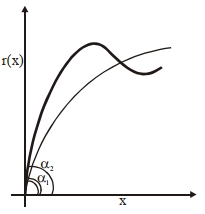
A projectile is launched from the origin in the $xy$ plane ( $x$ is the horizontal and $y$ is the vertically up direction) making an angle $\alpha$ from the $x$-axis. If its distance. $r =\sqrt{ x ^2+ y ^2}$ from the origin is plotted against $x$, the resulting curves show different behaviours for launch angles $\alpha_1$ and $\alpha_2$ as shown in the figure below. For $\alpha_1, r ( x )$ keeps increasing with $x$ while for $\alpha_2$, $r(x)$ increases and reaches a maximum, then decreases and goes through a minimum before increasing again. The switch between these two cases takes place at an angle $\alpha_c\left(\alpha_1 < \alpha_c < \alpha_2\right)$. The value of $\alpha_c$ is [ignore where $v_0$ is the initial speed of the projectile and $g$ is the acceleration due to gravity]