Question
Two circular loops are placed coaxially but separated by a distance. A battery is suddenly connected to one of the loops establishing a current in it. Will there be a current induced in the other loop? If yes, when does the current start and when does it end? Do the loops attract each other or do they repel?
Answer

When there is some current in first loop it will induce same polarity current in the second loop. It starts when the current is passed through first loop and ends when the current is stopped.
Loops repel each other as loops have current in same direction thus they have same pole as magnet.

Need a full question paper?

Generate a complete, print-ready paper with questions like this in minutes — across 16+ boards, with answer keys.

Start Generating Free

Similar questions

A small telescope has an objective lens of focal length 144 cm and an eyepiece of focal length 6.0 cm. What is the magnifying power of the telescope? What is the separation between the objective and the eyepiece?
What is the true weight of an object in a geostationary satellite that weighed exactly 10.0N at the north pole?
Explain the effect of electric potential (potential difference) on photoelectric current and derive the definition and formula of stopping potential.
Obtain approximately the ratio of the nuclear radii of the gold isotope $^{197}_{79}\text{Au}$ and the silver isotope $^{107}_{47}\text{Ag}.$
Two wires of different densities but same area of crosssection are soldered together at one end and are stretched to a tension T. The velocity of a transverse wave in the first wire is double of that in the second wire. Find the ratio of the density of the first wire to that of the second wire.
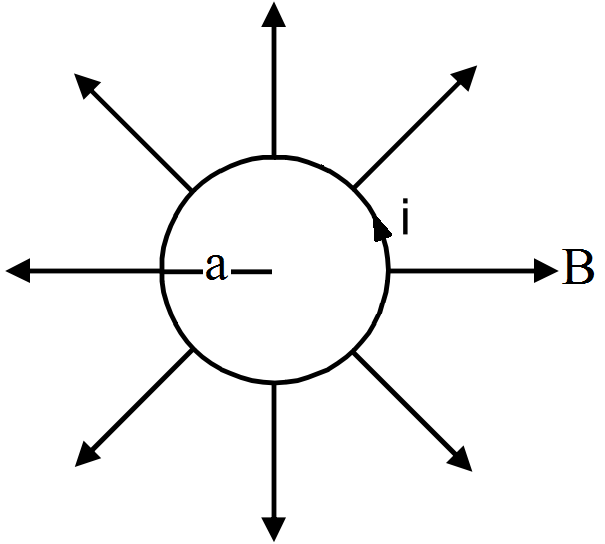
A circular loop of radius a, carrying a current i, is placed in a two-dimensional magnetic field. The centre of the loop coincides with the centre of the field The strength of the magnetic field at the periphery of the loop is B. Find the magnetic force on the wire.
  1. Draw circuit diagram and explain the working of a zener diode as a dc voltage regulator with the help of its I-V characteristic.
  2. What is the purpose of heavy doping of p- and n-sides of a zener diode?
Does a nucleus lose mass when it suffers gamma decay?
Find the ratio of the lengths of an iron rod and an aluminium rod for which the difference in the lengths is independent of temperature. Coefficients of linear expansion of iron and aluminium are ${12 \times 10^{-6}}  ^\circ C^{-1}$ and ${23 \times 10^{-6}}^\circ C^{-1}$ respectively.
A steel rod is rigidly clamped at its two ends. The rod is under zero tension at 20°C. If the temperature rises to 100°C, what force will the rod exert on one of the clampa? Area of Cross section of the rod $= 2.00mm^2.$ Coefficient of linear expansion of steel ${12.0 \times 10^{-6} }^\circ C^{-1}$ and Young's modulus of steel $= 2.00 \times 10^{11}N\ m^{-2}.$