Question
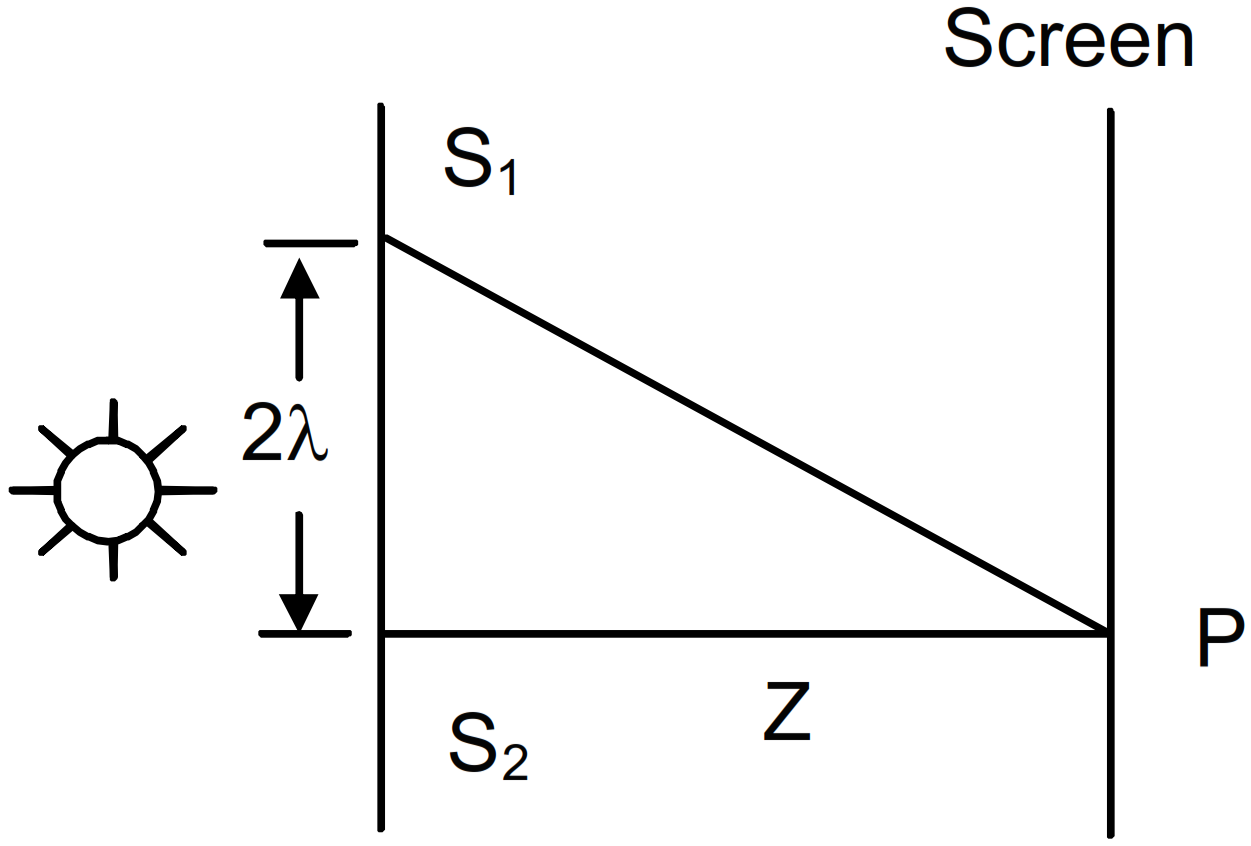
Two coherent point sources S1 and S2 vibrating in phase emit light of wavelength $\lambda$. The separation between the sources is $2\lambda$. Consider a line passing through S2 and perpendicular to the line S1S2. What is the smallest distance from S2 where a minimum of intensity occurs?
Answer

For minimum intensity

$\therefore\text{S}_1\text{P}-\text{S}_2\text{P}=\text{x}=(2\text{n}+1)\frac{\lambda}{2}$
From the figure, we get,
$\Rightarrow\sqrt{\text{X}^2+(2\lambda)^2}-\text{Z}=(2\text{n}+1)\frac{\lambda}{2}$
$\Rightarrow\text{Z}^2+4\lambda^2=\text{Z}^2+(2\text{n}+1)^2\frac{\lambda^2}{4}+\text{Z}(2\text{n}+1)\lambda$
$\Rightarrow\text{Z}=\frac{4\lambda^2-(2\text{n}+1)^2\Big(\lambda^2{4}\Big)}{(2\text{n}+1)\lambda}=\frac{16\lambda^2-(2\text{n}+1)^2\lambda^2}{4(2\text{n}+1)\lambda}\ ...(1)$
Putting, $\text{n}=0\Rightarrow\text{Z}=\frac{15\lambda}{4}$
$\text{n}=-1\Rightarrow\text{Z}=\frac{-15\lambda}{4}$
$\text{n}=1\Rightarrow\text{Z}=\frac{7\lambda}{12}$
$\text{n}=2\Rightarrow\text{Z}=\frac{-9\lambda}{20}$
$\therefore\text{Z}=\frac{7\lambda}{12}$ is the smallest distance for which there will be minimum intensity.

Need a full question paper?

Generate a complete, print-ready paper with questions like this in minutes — across 16+ boards, with answer keys.

Start Generating Free

Similar questions

A solenoid having inductance 4.0H and resistance $10\Omega$ is connected to a 4.0V battery at t = 0. Find
  1. The time constant.
  2. The time elapsed before the current reaches 0.63 of its steady-state value.
  3. The power delivered by the battery at this instant.
  4. The power dissipated in Joule heating at this instant.
When the sun is directly overhead, the surface of the earth receives 1.4 × 10³ W m-2 of sunlight. Assume that the light is monochromatic with average wavelength 500nm and that no light is absorbed in between the sun and the earth's surface. The distance between the sun and the earth is 1.5 × 10¹¹m.
  1. Calculate the number of photons falling per second on each square metre of earth's surface directly below the sun.
  2. How many photons are there in each cubic metre near the earth's surface at any instant?
  3. How many photons does the sun emit per second?
A small piece of cesium metal ($\phi$ = 1 ·9 eV) is kept at a distance of 20cm from a large metal plate having a charge density of 1.0 × 10⁻⁹C/m2 on the surface facing the cesium piece. A monochromatic light of wavelength 400nm is incident on the cesium piece. Find the minimum and the maximum kinetic energy of the photoelectrons reaching the large metal plate. Neglect any change in electric field due to the small piece of cesium present.
The plates of a parallel plate capacitor have an area of 90cm2 each and are separated by 2.5mm. The capacitor is charged by connecting it to a 400V supply.
  1. How much electrostatic energy is stored by the capacitor?
  2. View this energy as stored in the electrostatic field between the plates, and obtain the energy per unit volume u. Hence arrive at a relation between u and the magnitude of electric field E between the plates.
A pin of length 2.0cm lies along the principal axis of a converging lens, the centre being at a distance of 11cm from the lens. The focal length of the lens is 6cm. Find the size of the image.
Given below are two electrical circuits A and B. Calculate the ratio of power factor of circuit B to the power factor of circuit A.
The count rate of nuclear radiation coming from a radiation coming from a radioactive sample containing 128I varies with time as follows.
Time t(minute): 0 25 50 75 100
Ctount rate R(109s-1): 30 16 8.0 3.8 2.0
  1. Plot In $\Big(\frac{\text{R}_0}{\text{R}}\Big)$ against t.
  2. From the slope of the best straight line through the points, find the decay constant $\lambda.$
  3. Calculate the half-life $\text{t}_{\frac{1}{2}}.$
How many is energy states are present in one mole of sodium vapour? Are they all filled in normal conditions? "How many 3s energy states are present in one mole of sodium vapour? Are they all filled in normal conditions?
Verify the Gauss’s law for magnetic field of a point dipole of dipole moment m at the origin for the surface which is a sphere of radius R.
Derive the lens formula,  $\frac{1}{\text{f}} = \frac{1}{\text{v}} - \frac{1}{\text{u}}$ for a concave lens, using the necessary ray diagram.
Two lenses of powers 10 D and – 5 D are placed in contact.
  1. Calculate the power of the new lens.
  2. Where should an object be held from the lens, so as to obtain a virtual image of magnification 2?