Two electric bulbs $A$ and $B$ are rated as $60\, W$ and $100\, W$. They are connected in parallel to the same source. Then,
Easy
Download our app for free and get started
(c) $i \propto \frac{1}{R}$ and $P \propto \frac{1}{R}$ $ \Rightarrow $ $i \propto P$
i.e. in parallel bulb of higher power will draw more current.

Download our appand get started for free
Experience the future of education. Simply download our apps or reach out to us for more information. Let's shape the future of learning together!No signup needed.*
Similar Questions
- 1An unknown resistance $R_1$ is connected in series with a resistance of $10 \,\Omega$. This combinations is connected to one gap of a meter bridge while a resistance $R_2$ is connected in the other gap. The balance point is at $50\, cm$. Now, when the $10 \,\Omega$ resistance is removed the balance point shifts to $40\, cm$. The value of $R_1$ is (in $ohm$)View Solution
- 2In a meter bridge, the null point is found at a distance of $25\, cm$ from $A$. If now a resistance of $10\,\Omega $ is connected in parallel with $S$, the null point occurs at mid point of $AB$. The value of $R$ is ................. $\Omega$View Solution
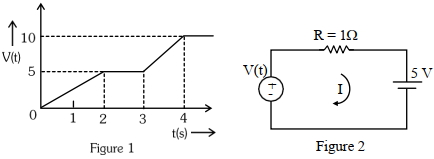
- 3For the circuit shown, the value of current at time ${t}=3.2\, {s}$ will be ...... ${A}$.View Solution
[Voltage distribution $V(t)$ is shown by Fig. $(1)$ and the circuit is shown in Fig. $(2)$]
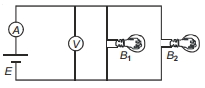
- 4Two identical bulbs are connected in parallel across an ideal source of emf $E$. The ammeter $A$ and voltmeter $V$ are ideal. If bulb $B_2$ gets fused, thenView Solution
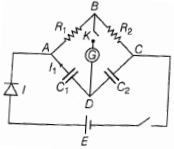
- 5ln the circuit in the figure, if no current flows through the galvanometer when the key $K$ is closed, the bridge is balanced. The balancing condition for bridge isView Solution
- 6A metal wire of specific resistance $64 \times {10^{ - 6}}\,ohm - cm$ and length $198\, cm$ has a resistance of $7\, ohm$, the radius of the wire will be ............. $cm$View Solution
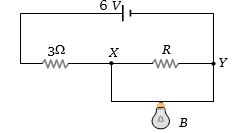
- 7In the following circuit, bulb rated as $1.5\, V$, $0.45\, W$. If bulbs glows with full intensity then what will be the equivalent resistance between $X$ and $Y$ ............. $\Omega$View Solution
- 8A wire of radius $r$ has resistance $R$. If it is stretched to a radius of $\frac{{3r}}{4}$, its resistance becomesView Solution
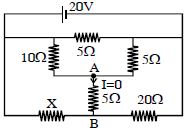
- 9In given circuit current through $AB$ is zero, then what will be the value of unknown resistance $'X'$ ............... $\Omega$View Solution
- 10View SolutionElectroplating does not help in