Two electric bulbs whose resistances are in the ratio of $1 : 2$ are connected in series. The powers dissipated in them have the ratio
AIPMT 1997, Easy
Download our app for free and get started
(a) In series, current is same in both the bulbs, hence $P \propto R\,(P = {i^2}R)$
$\therefore \frac{{{P_1}}}{{{P_2}}} = \frac{{{R_1}}}{{{R_2}}} = \frac{1}{2}$

Download our appand get started for free
Experience the future of education. Simply download our apps or reach out to us for more information. Let's shape the future of learning together!No signup needed.*
Similar Questions
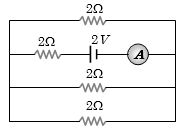
- 1View SolutionThe reading of the ammeter as per figure shown is
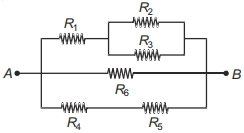
- 2View SolutionConsider the combination of resistors as shown in figure and pick out the correct statement
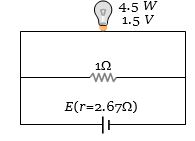
- 3A torch bulb rated as $4.5\, W$, $1.5\, V$ is connected as shown in the figure. The $e.m.f.$ of the cell needed to make the bulb glow at full intensity is ................ $V$View Solution
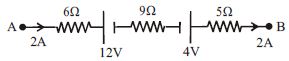
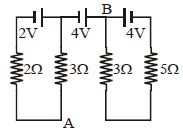
- 4In the given circuit calculate potential difference between $A$ and $B$ ............... $\mathrm{V}$View Solution
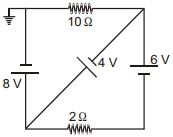
- 5In the circuit shown in figure, all cells are ideal. The current through $2 \,\Omega$ resistor is ............ $A$View Solution
- 6Two resistors are joined in parallel whose, resultant is $\frac{6}{5} \,\Omega$. One of the resistance wire is broken and the effective resistance becomes $2 \,ohms$. Then the resistance (in $ohm$) of the wire that got broken is ..........View Solution
- 7Two electric bulbs whose resistances are in the ratio of $1 : 2$ are connected in parallel to a constant voltage source. The powers dissipated in them have the ratioView Solution
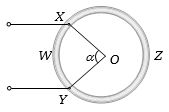
- 8A wire of resistor $R$ is bent into a circular ring of radius $r$. Equivalent resistance between two points $X$ and $Y$ on its circumference, when angle $XOY$ is $\alpha$, can be given byView Solution
- 9An electric bulb is designed to draw power $P_0$ at voltage $V_0$. If the voltage is $V$ it draws a power $P$. ThenView Solution
- 10The potential difference between $A$ and $B$ in the Figure is .............. $V$View Solution