MCQ
Two equal rods joined at one end are kept on a smooth surface as shown and released. Trajectory of centre of mass of both rods is 
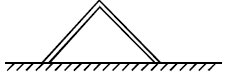
  • A
    parabola
  • straight vertical line
  • C
    straight inclined line
  • D
    straight horizontal line

Answer

Correct option: B.
straight vertical line
b

Need a full question paper?

Generate a complete, print-ready paper with questions like this in minutes — across 16+ boards, with answer keys.
Start Generating Free

Similar questions

The total kinetic energy of 8 litres of helium molecules at 5 atmosphere pressure will be:
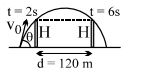
A projectile crosses two walls of equal height $H$ symmetrically as shown The height of each wall is  ........ $m$
Given below are two statements: one is labelled as Assertion$(A)$ and the other is labelled as Reason $(R).$

$Assertion$ $(A)$ : In Vernier calliper if positive zero error exists, then while taking measurements, the reading taken will be more than the actual reading.

$Reason$ $(R)$ : The zero error in Vernier Calliper might have happened due to manufacturing defect or due to rough handling.

In the light of the above statements, choose the correct answer from the options given below :
The height upto which water will rise in a capillary tube will be
$1\, g$ of a steam at $100°C$ melt ........ $gm$ ice at $0°C\,?$ $($Latent heat of ice $= 80 \,cal/gm$ and latent heat of steam $= 540\, cal/gm)$
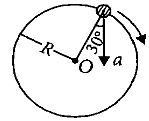
In the given figure, $a = 15 \,m s^{- 2}$ represents the total acceleration of a particle moving in the clockwise direction in a circle of radius $R = 2.5\, m$ at a given instant of  time. The speed of the particle is ........ $m/s$
Velocity of sound is maximum in
The string of a violin emits a note of $205 \,Hz$ at its correct tension. The string is tightened slightly and then it produces six beats in two seconds with a tuning fork of frequency $205 Hz$. The frequency of the note emitted by the taut string is .......... $Hz$ 
A particle is acted upon by a force of constant magnitude which is always perpendicular to the velocity of the particle. The motion of the particle takes place in a plane. It follows that  
In isothermal, isobaric and adiabatic processes, the value of work done for equal volume change is minimum: