Two equations of two $S.H.M.$ are $y = a\sin \,(\omega \,t - \alpha )$ and $y = b\cos (\omega \,t - \alpha )$. The phase difference between the two is .... $^o$
Easy


Download our appand get started for free
Experience the future of education. Simply download our apps or reach out to us for more information. Let's shape the future of learning together!No signup needed.*
Similar Questions
- 1A bead of mass $m$ is attached to the mid-point of a tant, weightless string of length $l$ and placed on a frictionless horizontal table.Under a small transverse displacement $x$, as shown in above figure. If the tension in the string is $T$, then the frequency of oscillation isView Solution
- 2A particle executing a simple harmonic motion of period $2\ s$ . When it is at its extreme displacement from its mean position, it receives an additional energy equal to what it had in its mean position. Due to this , in its subsequent motion,View Solution
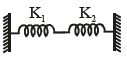
- 3View SolutionThe effective spring constant of two spring system as shown in figure will be
- 4A pendulum suspended from the ceiling of a train has a period $T$, when the train is at rest. When the train is accelerating with a uniform acceleration a, the period of oscillation willView Solution
- 5Two particle executing $S.H.M.$ of same amplitude of $20 \,cm$ with same period along the same line about same equilibrium position. The maximum distance between the two is $20 \,cm$. Their phase difference in radian is equal toView Solution
- 6The period of oscillation of a mass $M$ suspended from a spring of negligible mass is $T$. If along with it another mass $M$ is also suspended , the period of oscillation will now beView Solution
- 7Two particles undergo $SHM$ along parallel lines with the same time period $(T)$ and equal amplitudes. At a particular instant, one particle is at its extreme position while the other is at its mean position. They move in the same direction. They will cross each other after a further timeView Solution
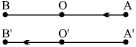
- 8A vibratory motion is represented by $x = 2A\,\cos \omega t + A\,\cos \,\left( {\omega t + \frac{\pi }{2}} \right) + A\,\cos \,\left( {\omega t + \pi } \right)$ $ + \frac{A}{2}\,\cos \left( {\omega t + \frac{{3\pi }}{2}} \right)$. The resultant amplitude of the motion isView Solution
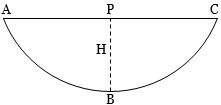
- 9A simple pendulum with a bob of mass $‘m’$ oscillates from $A$ to $ C$ and back to $A$ such that $PB$ is $H.$ If the acceleration due to gravity is $‘g’$, then the velocity of the bob as it passes through $B$ isView Solution
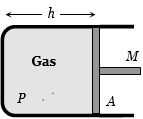
- 10A cylindrical piston of mass $M$ slides smoothly inside a long cylinder closed at one end, enclosing a certain mass of gas. The cylinder is kept with its axis horizontal. If the piston is disturbed from its equilibrium position, it oscillates simple harmonically. The period of oscillation will beView Solution