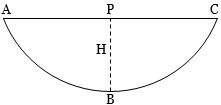
A simple pendulum with a bob of mass $‘m’$ oscillates from $A$ to $ C$ and back to $A$ such that $PB$ is $H.$ If the acceleration due to gravity is $‘g’$, then the velocity of the bob as it passes through $B$ is
AIPMT 1995, Medium
Download our app for free and get started
(b) At $B$, the velocity is maximum using conservation of mechanical energy
$\Delta PE = \Delta KE$
==> $mgH = \frac{1}{2}m{v^2}$
==> $v = \sqrt {2gH} $

Download our appand get started for free
Experience the future of education. Simply download our apps or reach out to us for more information. Let's shape the future of learning together!No signup needed.*
Similar Questions
- 1For a particle executing simple harmonic motion, the kinetic energy $K$ is given by $K = {K_o}{\cos ^2}\omega t$. The maximum value of potential energy isView Solution
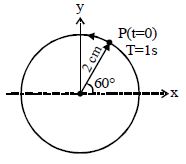
- 2Figure shows the circular motion of a particle. The radius of the circle, the period, sense of revolution and the initial position are indicated in the figure. The simple harmonic motion of the $x-$ projection of the radius vector of the rotating particle $P$ isView Solution
- 3The amplitude and the periodic time of a $S.H.M.$ are $ 5\,cm$ and $6\,sec$ respectively. At a distance of $2.5\,cm$ away from the mean position, the phase will beView Solution
- 4A pendulum suspended from the ceiling of a train has a period $T$, when the train is at rest. When the train is accelerating with a uniform acceleration a, the period of oscillation willView Solution
- 5The position, velocity and acceleration of a particle executing simple harmonic motion are found to have magnitudes of $4 \mathrm{~m}, 2 \mathrm{~ms}^{-1}$ and $16 \mathrm{~ms}^{-2}$ at a certain instant. The amplitude of the motion is $\sqrt{\mathrm{x}} \mathrm{m}$ where $\mathrm{x}$ is. . . . . . .View Solution
- 6An oscillator of mass $M$ is at rest in its equilibrium position in a potential $V\, = \,\frac{1}{2}\,k{(x - X)^2}.$ A particle of mass $m$ comes from right with speed $u$ and collides completely inelastically with $M$ and sticks to it . This process repeats every time the oscillator crosses its equilibrium position .The amplitude of oscillations after $13$ collisions is: $(M = 10,\, m = 5,\, u = 1,\, k = 1 ).$View Solution
- 7The length of a simple pendulum is increased by $2\%$. Its time period willView Solution
- 8If the displacement equation of a particle be represented by $y = A\sin PT + B\cos PT$, the particle executesView Solution
- 9The displacement of a particle varies with time as $x = 12\sin \omega t - 16{\sin ^3}\omega t$ (in $cm$). If its motion is $S.H.M.$, then its maximum acceleration isView Solution
- 10View SolutionIn damped oscillation graph between velocity and position will be