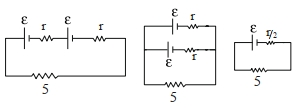
Two identical cells, when connected either in parallel or in series gives same current in an external resistance $5\,\Omega$. The internal resistance of each cell will be $.............\,\Omega$.
JEE MAIN 2023, Medium


Download our appand get started for free
Experience the future of education. Simply download our apps or reach out to us for more information. Let's shape the future of learning together!No signup needed.*
Similar Questions
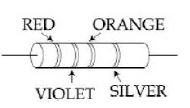
- 1View SolutionA resistance is shown in the figure. Its value and tolerance are given respectively by
- 2Every atom makes one free electron in copper. If $1.1$ $ampere$ current is flowing in the wire of copper having $1\, mm$ diameter, then the drift velocity (approx.) will be (Density of copper $ = 9 \times {10^3}\,kg\,{m^{ - 3}}$ and atomic weight = $63$)View Solution
- 3There are $8$ equal resistances $R$. Two are connected in parallel, such four groups are connected in series, the total resistance of the system will beView Solution
- 4How many calories of heat will be produced approximately in a $210\, watt$ electric bulb in $5$ minutes .............. $cal $View Solution
- 5View SolutionThe resistance of a conductor increases with
- 6In the given figure, when key $A$ is opened, the reading of the ammeter $A$ will be ........... $A$View Solution
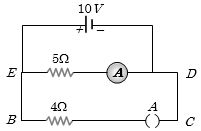
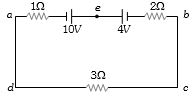
- 7View SolutionThe magnitude and direction of the current in the circuit shown will be
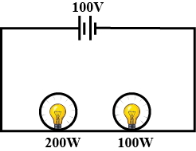
- 8Two bulbs, one of $200 \,W$ and the other of $100 \,W$ are connected in series with a $100 \,V$ battery which has no internal resistance. Then,View Solution
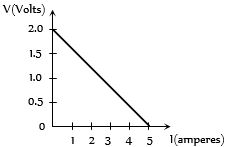
- 9For a cell, the graph between the potential difference $(V) $ across the terminals of the cell and the current $(I)$ drawn from the cell is shown in the figure. The $e.m.f.$ and the internal resistance of the cell areView Solution
- 10View SolutionKirchhoff's second law is based on the law of conservation of