Two identical springs of spring constant $'2k'$ are attached to a block of mass $m$ and to fixed support (see figure). When the mass is displaced from equilibrium position on either side, it executes simple harmonic motion. The time period of oscillations of this sytem is ...... .
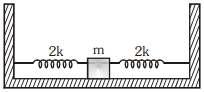
JEE MAIN 2021, Medium


Download our appand get started for free
Experience the future of education. Simply download our apps or reach out to us for more information. Let's shape the future of learning together!No signup needed.*
Similar Questions
- 1Vertical displacement of a plank with a body of mass $'m'$ on it is varying according to law $y = \sin \omega t + \cos \omega t.$ The minimum value of $\omega $ for which the mass just breaks off the plank and the moment it occurs first after $t = 0$ are given by : ( $y$ is positive vertically upwards)View Solution
- 2A trolley of mass $m_1$ is placed on horizontal rigid pair of rails at same height. A mass $m_2$ is suspended to the trolley vertically by me ans of a ideal massless rope. The rope hangs between rails without touching them. Trolley can move along smooth rails but can't move in any other direction. Suspended mass is given small oscillation and perform $SHM$ after displacing small from stable equilibrium position in two ways, first perpendicular to the rails and second parallel to the rails. The ratio of time period of these (second case to first case) two $SHM's$ isView Solution
- 3An object of mass $0.2\, kg$ executes simple harmonic along $X-$ axis with frequency of $\frac{{25}}{\pi }Hz$. At the position $x = 0.04m$, the object has kinetic energy of $0.5 \,J$ and potential energy of $0.4\, J$ amplitude of oscillation in meter is equal toView Solution
- 4A pendulum clock that keeps correct time on the earth is taken to the moon it will run (it is given that $g_{Moon} = g_{Earth}/6$ )View Solution
- 5When a mass $m$ is attached to a spring, it normally extends by $0.2\, m$. The mass $m$ is given a slight addition extension and released, then its time period will beView Solution
- 6For a particle executing $S.H.M.,\, x =$ displacement from equilibrium position, $v =$ velocity at any instant and $a =$ acceleration at any instant, thenView Solution
- 7A cuboidal piece of wood has dimensions $a, b$ and $c$. Its relative density is $d$. It is floating in a large body of water such that side a is vertical. It is pushed down a bit and released. The time period of $SHM$ executed by it is :View Solution
- 8Two springs of force constants $300\, N/m$ (Spring $A$) and $400\, N/m$ (Spring $B$) are joined together in series . The combination is compressed by $8.75\, cm$. The ratio of energy stored in $A$ and $B$ is $\frac{{{E_A}}}{{{E_B}}}$. Then $\frac{{{E_A}}}{{{E_B}}}$ is equal toView Solution
- 9The potential energy of a particle of mass $1\, kg$ in motion along the $x-$ axis is given by $U = 4\,(1 -cos\,2x)$, where $x$ is in $metres$ . The period of small oscillation (in $second$ ) isView Solution
- 10A particle is executing $SHM$ about $y=0$ along $y$-axis. Its position at an instant is given by $y=(7 \,m )$ sin( $\pi f)$. Its average velocity for a time interval $0$ to $0.5 \,s$ is ........... $m / s$View Solution