Question
Two long strings $A$ and $B,$ each having linear mass density $1.2 \times 10^{-2}\ kg/m$, are stretched by different tensions $4.8N$ and $7.5N$ respectively and are kept parallel to each other with their left ends at $x = 0.$ Wave pulses are produced on the strings at the left ends at $t = 0$ on string $A$ and at $t = 20\ ms$ on string $B.$ When and where will the pulse on $B$ overtake that on $A$?
Answer

$\text{m}_\text{A}=1.2\times10^{-2}\text{ kg/m},\ \text{T}_\text{A}=4.8\text{N}$
$\Rightarrow\text{v}_\text{A}=\sqrt{\frac{\text{T}}{\text{m}}}=20\text{m/s}$
$\text{m}_\text{B}=1.2\times10^{-2}\text{kg/m},\ \text{T}_\text{B}=7.5\text{N}$
$\Rightarrow\text{V}_\text{B}=\sqrt{\frac{\text{T}}{\text{m}}}=25\text{m/s}$
$\text{t}=0$ in string $A$
$\text{t}_1=0+20\text{ ms}=20\times10^{-3}=0.02\text{ sec}$
In $0.02 \sec A$ has travelled $20\times0.02=0.4\text{mt}$
Relative speed between $A$ and $B =25-20=5\text{m/s}$
Time taken for $B$ for overtake $A =\frac{\text{s}}{\text{v}}=\frac{0.4}{5}=0.08\text{ sec}$

Need a full question paper?

Generate a complete, print-ready paper with questions like this in minutes — across 16+ boards, with answer keys.

Start Generating Free

Similar questions

Air $(\gamma=1.4)$ is pumped at $2\ atm$ pressure in a motor tyre at $20^\circ C$. If the tyre suddenly bursts, what would be the temperature of the air coming out of the tyre? Neglect any mixing with the atmospheric air.
In a $p-n$ junction, the depletion region is $400\ nm$ wide and an electric field of $5 \times 10^5\ V/m$ exists in it.
  1. Find the height of the potential barrier.
  2. What should be the minimum kinetic energy of a conduction electron which can diffuse from the $n-$side to the $p-$side?
A nearsighted person cannot see beyond 25cm. Assuming that the separation of them glass from the eye is 1cm, find the power of lens needed to see distant objects.
A simple pendulum of lerigth $1$ feet suspended from the ceiling of an elevator takes $\frac{\pi}{3}$ seconds to complete one oscillation. Find the acceleration of the elevator.
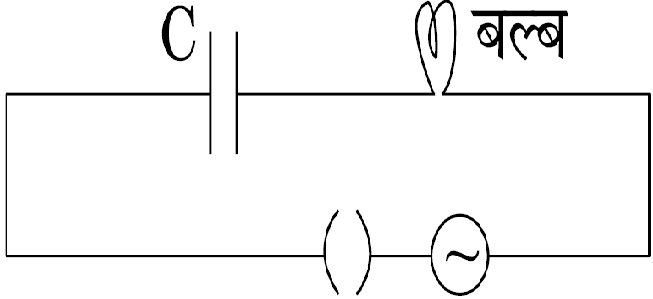
  1. When an AC source is connected to an ideal capacitor, show that the average power supplied by the source over a complete cycle is zero.
  2. A bulb is connected in series with a variable capacitor and an A.C. source as shown. What happens to the brightness of the bulb when the key is the capacitor is gradually reduced?
Explain giving reasons for the following:
  1. Photoelectric current in a photocell increases with the increase in the intensity of the incident radiation.
  2. The stopping potential $(V_0)$ varies linearly with the frequency $(v)$ of the incident radiation for a given photosensitive surface with the slope remaining the same for different surfaces.
  3. Maximum kinetic energy of the photoelectrons is independent of the intensity of incident radiation.
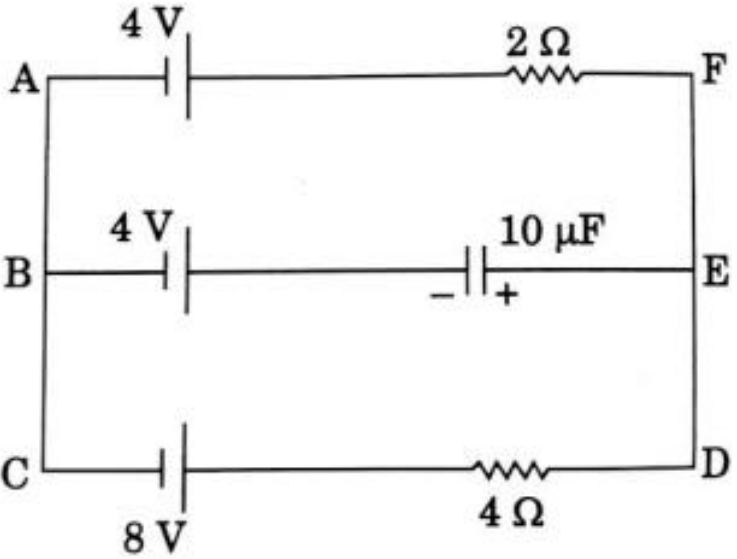
In the given circuit, with steady current, calculate the potential drop across the capacitor and the charge stored in it.
A uranium reactor develops thermal energy at a rate of $300\ MW$. Calculate the amount of $^{235}U$ being consumed every second. Average released per fission is $200\ MeV$.
The electric field in a region is given by $\overrightarrow{\text{E}}=\frac{3}{5}\text{E}_0\overrightarrow{\text{i}}+\frac{4}{5}\text{E}_0\overrightarrow{\text{j}}$ with $\text{E}_0=2.0\times10^3\text{NC}^{-1}.$ Find the flux of this field through a rectangular surface of area $0.2m^2$ parallel to the $y-z$ plane.
Two sources of sound $, S_1$ and $S_2,$ emitting waves of equal wavelength $20.0\ cm,$ are placed with a separation of $20.0\ cm$ between them. A detector can be moved on a line parallel to $S_1 ,S_2,$ and at a distance of $20.0\ cm$ from it. Initially, the detector is equidistant from the two sources. Assuming that the waves emitted by the sources are in phase, find the minimum distance through which the detector should be shifted to detect a minimum of sound.