Two masses $m_1=1 \,kg$ and $m_2=0.5 \,kg$ are suspended together by a massless spring of spring constant $12.5 \,Nm ^{-1}$. When masses are in equilibrium $m_1$ is removed without disturbing the system. New amplitude of oscillation will be .......... $cm$
Medium
Download our app for free and get started
(c)
Points of equilibrium of the spring will be when no force acts on it.
$k x=\left(m_1+m_2\right) g$
$x=\frac{\left(m_1+m_2\right) g}{k}$
The new equilibrium position which will be the mean position of $S.H.M.$ will be simply $\frac{m_2 g}{k}$
New amplitude will be maximum displacement from $\frac{m_2 g}{k}$ which is :
$A=\frac{\left(m_1+m_2\right) g}{k}-\frac{m_2 g}{k}$
or $A=\frac{m_1 g}{k}$
or $A=\frac{1 \times 10}{12.5}$
or $A=\frac{4}{5} \,m$
$\therefore A=0.8 \,m$ or $80 \,cm$

Download our appand get started for free
Experience the future of education. Simply download our apps or reach out to us for more information. Let's shape the future of learning together!No signup needed.*
Similar Questions
- 1A particle executes simple harmonic motion along a straight line with an amplitude $A$. The potential energy is maximum when the displacement isView Solution
- 2In an elevator, a spring clock of time period $T_S$ (mass attached to a spring) and a pendulum clock of time period $T_P$ are kept. If the elevator accelerates upwardsView Solution
- 3The maximum velocity of a simple harmonic motion represented by $y = 3\sin \,\left( {100\,t + \frac{\pi }{6}} \right)$is given byView Solution
- 4lfa simple pendulum has significant amplitude (up to a factor of $1/e$ of original) only in the period between $t = 0\ s$ to $t = \tau \ s$, then $\tau$ may be called the average life of the pendulum. When the spherical bob of the pendulum suffers a retardation ( due to viscous drag) proportional to its velocity with $b$ as the constant of proportionality, the average life time of the pendulum is (assuming damping is small) in secondsView Solution
- 5A body performs $S.H.M.$ Its kinetic energy $K$ varies with time $t$ as indicated by graphView Solution
- 6The equation of motion of a particle is $\frac{{{d^2}y}}{{d{t^2}}} + Ky = 0$, where $K$ is positive constant. The time period of the motion is given byView Solution
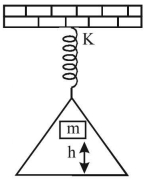
- 7A load of mass $m$ falls from a height $h$ on to the scale pan hung from the spring as shown in the figure. If the spring constant is $k$ and mass of the scale pan is zero and the mass $m$ does not bounce relative to the pan, then the amplitude of vibration isView Solution
- 8Assume that the earth is a solid sphere of uniform density and a tunnel is dug along its diameter throughout the earth. It is found that when a particle is released in this tunnel, it executes a simple harmonic motion. The mass of the particle is $100 g$. The time period of the motion of the particle will be (approximately) (take $g =10\,ms ^{-2}$, radius of earth $=6400\,km$ )View Solution
- 9View SolutionIn case of a simple pendulum, time period versus length is depicted by
- 10The angular velocities of three bodies in simple harmonic motion are ${\omega _1},\,{\omega _2},\,{\omega _3}$ with their respective amplitudes as ${A_1},\,{A_2},\,{A_3}$. If all the three bodies have same mass and velocity, thenView Solution