Question
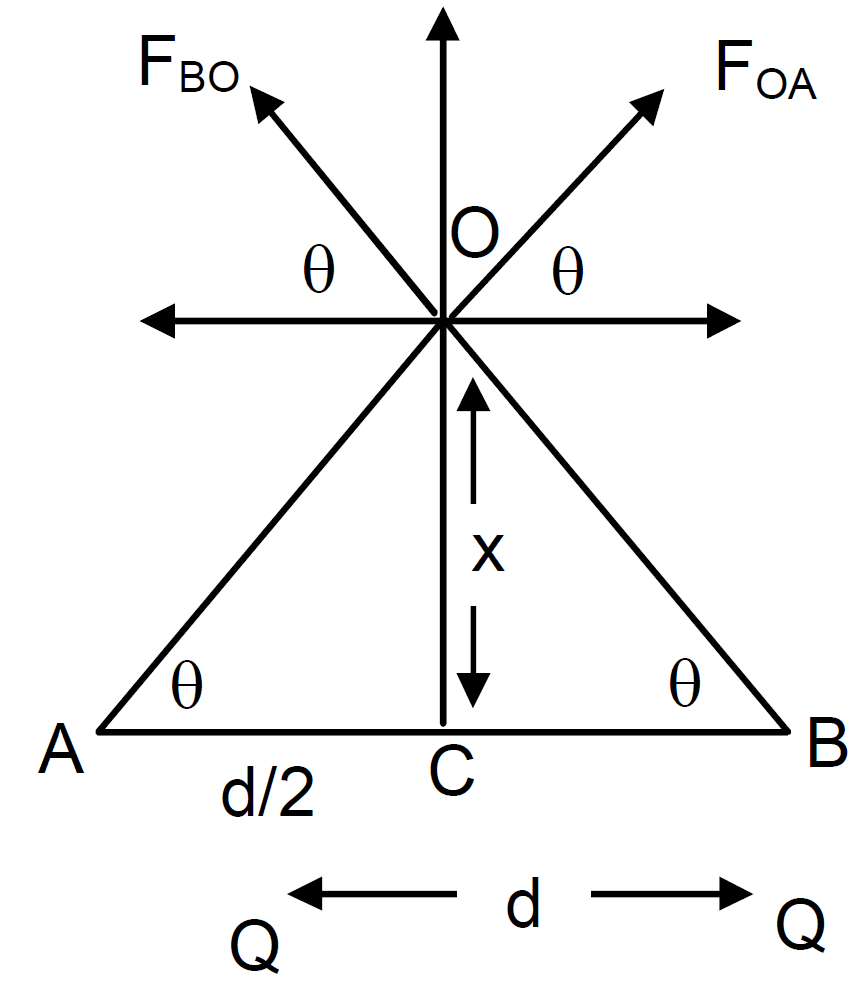
Two particles A and B, each carrying a charge Q, are held fixed with a separation d between them. A particle C having mass m and charge q is kept at the middle point of the line AB.
  1. If it is displaced through a distance x perpendicular to AB, what would be the electric force experienced by it.
  2. Assuming x << d, show that this force is proportional to x.
  3. Under what conditions will the particle C execute simple harmonic motion if it is released after such a small displacement?
Find the time period of the oscillations if these conditions are satisfied.

Answer


  1. Let Q = charge on A & B Separated by distance d
q = charge on c displaced $\bot$ to -AB

So, force on $0=\overline{\text{F}}_\text{AB}+\overline{\text{F}}_\text{BO}$

But $\text{F}_\text{AO}\cos\theta=\text{F}_\text{BO}\cos\theta$

So, force on ‘0’ in due to vertical component.

$\overline{\text{F}}=\text{F}_\text{AO}\sin\theta+\text{F}_\text{BO}\sin\theta$ $|\text{F}_\text{AO}|=|\text{F}_\text{BO}|$

$=2\frac{\text{KQq}}{\Big(\frac{\text{d}}{2^2+\text{x}^2}\big)}\sin\theta$

$\text{F}=\frac{2\text{KQq}}{\Big(\frac{\text{d}}{2}\Big)^2+\text{x}^2}\sin\theta$

$=\frac{4\times2\times2\text{KQq}}{(\text{d}^2+4\text{x}^2)}\times\frac{\text{x}}{\Big[\big(\frac{\text{d}}{2}\big)^2+\text{x}^2\Big]^{\frac{1}{2}}}$

$=\frac{2\text{kQq}}{\Big[\big(\frac{\text{d}}{2}\big)^2+\text{x}^2\Big]^{\frac{3}{2}}}\text{x}$ = Electric force $\Rightarrow\text{F}\propto\text{x}$
  1. When x << d
$\text{F}=\frac{2\text{kQq}}{\Big[\big(\frac{\text{d}}{2}\big)^2+\text{x}^2\Big]^{\frac{3}{2}}}\text{x}$ x << d

$\Rightarrow\text{F}=\frac{2\text{kQq}}{\Big(\frac{\text{d}^2}{4}\Big)^{\frac{3}{2}}}\text{x}\Rightarrow\text{F}\propto\text{x}$

$\text{a}=\frac{\text{F}}{\text{m}}=\frac{1}{\text{m}}\Bigg[\frac{2\text{kQqx}}{\Big[\big(\frac{\text{d}^2}{4}\big)+\ell^2}\Bigg]$

So time period $\text{T}=2\pi\sqrt{\frac{\ell}{\text{g}}}$

$=2\pi\sqrt{\frac{\ell}{\text{a}}}$

Need a full question paper?

Generate a complete, print-ready paper with questions like this in minutes — across 16+ boards, with answer keys.

Start Generating Free

Similar questions

A battery of emf 100V and a resistor of resistance $10\text{k}\Omega$ are joined in series. This system is used as a source to supply current to an external resistance R. If R is not greater than $100\Omega,$ the current through it is constant up to two significant digits. Find its value. This is the basic principle of a constant-current source.
A particle of mass m and charge q is projected into a region that has a perpendicular magnetic field B. Find the angle of deviation of the particle as it comes out of the magnetic field if the width d of the region is very slightly smaller than
  1. $\frac{\text{mv}}{\text{qB}}$
  2. $\frac{\text{mv}}{2\text{qB}}$
  3. $\frac{2\text{mv}}{\text{qB}}.$
$i$. Using Huygens's construction of secondary wavelets explains how a diffraction pattern is obtained on a screen due to a narrow slit on which a monochromatic beam of light is incident normally.
$ii.$ Show that the angular width of first diffraction fringe is half that of the central fringe.
$iii.$ Explain why the maxima at $\theta=\left(n+\frac{1}{2}\right) \frac{\lambda}{a}$ a become weaker and weaker with increasing $n$.
Each of the capacitors shown in figure has a capacitance of $2\mu\text{F}.$ Find the equivalent capacitance of the assembly between the points A and B. Suppose, a battery of emf 60 volts is connected between A and B. Find the potential difference appearing on the individual capacitors.
Calculate the increase in the internal energy of 10 g of water when it is heated from $0^{\circ} \mathrm{C}$ to $100^{\circ} \mathrm{C}$ and converted into steam at 100 kPa . The density of steam $=0.6 \mathrm{~kg} / \mathrm{m}^{-3}$. Specific heat capacity of water $=4200 \mathrm{~J} / \mathrm{kg}^{-10} \mathrm{C}^{-1}$ and the Jatent heat of vaporization of water $=2.25 \times 10^6 \mathrm{~J} / \mathrm{kg}^{-1}$.
Study the circuits (a) and (b) shown in Fig. and answer the following questions.
  1. Under which conditions would the rms currents in the two circuits be the same?
  2. Can the rms current in circuit (b) be larger than that in (a)?
  1. In the explanation of photo electric effect, we asssume one photon of frequency ν collides with an electron and transfers its energy. This leads to the equation for the maximum energy $E_{max}$ of the emitted electron as,
$\text{E}_\text{max}=\text{hv}-\phi_0$

where $\phi_0$ is the work function of the metal. If an electron absorbs 2 photons (each of frequency ν ) what will be the maximum energy for the emitted electron?
  1. Why is this fact (two photon absorption) not taken into consideration in our discussion of the stopping potential?
Consider the de Broglie wavelength of an electron and a proton. Which wavelength is smaller if the two particles have.
  1. The same speed.
  2. The same momentum.
  3. The same energy?.
An atom is in its excited state. Does the probability of its coming to ground state depend on whether the radiation is already present or not? If yes, does it also depend on the wavelength of the radiation present?
In a CE transistor amplifier there is a current and voltage gain associated with the circuit. In other words there is a power gain. Considering power a measure of energy, does the circuit voilate conservation of energy?