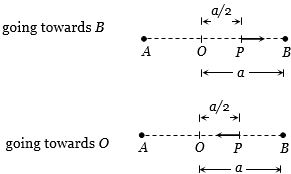
Two particles are oscillating along two close parallel straight lines side by side, with the same frequency and amplitudes. They pass each other, moving in opposite directions when their displacement is half of the amplitude. The mean positions of the two particles lie on a straight line perpendicular to the paths of the two particles. The phase difference is
A$\pi$
B$\frac{\pi}{6}$
C$0$
D$\frac{2 \pi}{3}$
AIPMT 2011, Diffcult
Download our app for free and get started
D$\frac{2 \pi}{3}$
d (d) $y = a\sin (\omega t + {\phi _0})$. According to the question
$ \Rightarrow (\omega \,t + {\phi _0}) = \phi = \frac{\pi }{6}$ or $\frac{{5\pi }}{6}$
Physical meaning of $\phi = \frac{\pi }{6}$ : Particle is at point $P$ and it is going towards B
Physical meaning of $\phi = \frac{{5\pi }}{6}$ : Particle is at point $P$ and it is going towards $O$
So phase difference $\Delta \phi = \frac{{5\pi }}{6} - \frac{\pi }{6} = \frac{{2\pi }}{3} = 120^\circ $
Download our app
and get started for free
Experience the future of education. Simply download our apps or reach out to us for more information. Let's shape the future of learning together!No signup needed.*
Consider two identical springs each of spring constant $k$ and negligible mass compared to the mass $M$ as shown. Fig. $1$ shows one of them and Fig. $2$ shows their series combination. The ratios of time period of oscillation of the two $SHM$ is $\frac{ T _{ b }}{ T _{ a }}=\sqrt{ x },$ where value of $x$ is
In a simple harmonic oscillation, what fraction of total mechanical energy is in the form of kinetic energy, when the particle is midway between mean and extreme position.
A body executing simple harmonic motion has a maximum acceleration equal to $ 24\,metres/se{c^2} $ and maximum velocity equal to $ 16\;metres/sec $. The amplitude of the simple harmonic motion is
In the given figure, a mass $M$ is attached to a horizontal spring which is fixed on one side to a rigid support. The spring constant of the spring is $k$. The mass oscillates on a frictionless surface with time period $T$ and amplitude $A$. When the mass is in equilibrium position, as shown in the figure, another mass $m$ is gently fixed upon it. The new amplitude of oscillation will be
Two damped spring-mass oscillating systems have identical spring constants and decay times. However, system $A's$ mass $m_A$ is twice system $B's$ mass $m_B$ . How do their damping constants, $b$ , compare ?
The length of a spring is $l$ and its force constant is $k$. When a weight $W$ is suspended from it, its length increases by $x$. If the spring is cut into two equal parts and put in parallel and the same weight $W$ is suspended from them, then the extension will be
A mass of $2.0\, kg$ is put on a flat pan attached to a vertical spring fixed on the ground as shown in the figure. The mass of the spring and the pan is negligible. When pressed slightly and released the mass executes a simple harmonic motion. The spring constant is $200\, N/m.$ What should be the minimum amplitude of the motion so that the mass gets detached from the pan (take $g = 10 m/s^2$).
A particle executes simple harmonic motion and is located at $x = a, b$ and $c$ at times $t_0, 2t_0$ and $3t_0$ respectively. The frequency of the oscillation is