MCQ
Two particles are projected from the same point with the same speed at different angles $\theta _1$ and $\theta _2$ to the horizontal. They have the same range. Their times of flight are $t_1$ and $t_2$ respectively.
  • A
    ${\theta _1} = 90 - {\theta _2}$
  • B
    $\frac{{{t_1}}}{{\sin \,{\theta _1}}} = \frac{{{t_2}}}{{\sin \,{\theta _2}}}$
  • C
    $\frac{{{t_1}}}{{{t_2}}} = \tan \,{\theta _1}$
  • All of the above

Answer

Correct option: D.
All of the above
d
For same ranges angles of projection are complimentry.

Need a full question paper?

Generate a complete, print-ready paper with questions like this in minutes — across 16+ boards, with answer keys.

Start Generating Free

Similar questions

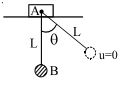
$A$ small ball $B$ of mass $m$ is suspended with light inelastic string of length $L$ from $a$ block $A$ of same mass $m$ which can move on smooth horizontal surface as shown in the figure. The ball is displaced by angle $\theta$ from equilibrium position & then released. Tension in string when it is vertical, is
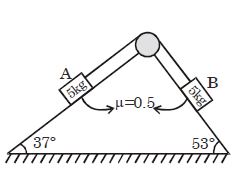
In the shown arrangement if $f_A\,,\, f_B$ and $T$ be the frictional forces on $A$ Block, $B$ Block and tension in the string respectively, then their values are
Consider a vector $\overrightarrow F = 4\hat i - 3\hat j.$ Another vector that is perpendicular to $\overrightarrow F $ is
A projectile is fired from the surface of the earth with a velocity of  $5 \,m s^{-1}$ and angle $\theta$ with the horizontal. Another projectile fired from another planet with a velocity of $3 \,m s^{-1}$ at the same angle follows a trajectory which is identical with the trajectory of the projectile fired from the earth. The value of the acceleration due to gravity on the planet is (in $\,m s^{-1}$) is 
(Given $g = 9.8 \,m s^{-2}$) 
A nucleus moving with a velocity $\vec{\text{v}}$ emits an $\alpha -$particle. Let the velocities of the $\alpha -$particle and the remaining nucleus be $\vec{\text{v}}_1$ and $\vec{\text{v}}_2$ and their masses be $m_1$ and $m_2$.
Three forces are acting simultaneously at one point. Two forces $\overrightarrow{ P }, \overrightarrow{ Q }$ are $(2 \hat{i}-3 \hat{j})$ and $(\hat{i}-\hat{j})$ respectively. If the object is in equilibrium then which will be the third:
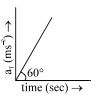
Tangential acceleration of a particle moving in a circle of radius $1$ $m$ varies with time $t$ as (initial velocity of particle is zero). Time after which total acceleration of particle makes and angle of $30^o$ with radial acceleration is
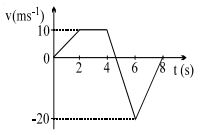
 The figure shows a velocity-time graph of a particle moving along a straight line. The particle comes to rest at $t=$ ....... $\sec$
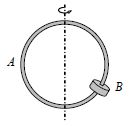
A small $100$ $g$ sleeve $B$ can slide on a smooth, circular and rigid wire frame $A$ of radius $5$ $m$ placed in vertical place. The wire frame is rotating about its vertical diameter at $2$ $rad/s$. When the sleeve is brought at a particular angular position other than the bottom and the top of the ring, the sleeve will not slide on the wire frame. ......... $N$ is force of interaction between the sleeve and the wire frame at this position.
Young's modulus depends upon