MCQ
Two particles $P$ and $Q$ start from origin and execute Simple Harmonic Motion along $X-$axis with same amplitude but with periods $3$ seconds and $6$ seconds respectively. The ratio of the velocities of $ P$ and $Q$ when they meet is
  • A
    $1:2$
  • $2:1$
  • C
    $2:3$
  • D
    $3:2$

Answer

Correct option: B.
$2:1$
b
(b) The particles will meet at the mean position when $P$ completes one oscillation and $Q$ completes half an oscillation
So $\frac{{{v_P}}}{{{v_Q}}} = \frac{{a{\omega _P}}}{{a{\omega _Q}}} = \frac{{{T_Q}}}{{{T_P}}} = \frac{6}{3} = \frac{2}{1}$

Need a full question paper?

Generate a complete, print-ready paper with questions like this in minutes — across 16+ boards, with answer keys.

Start Generating Free

Similar questions

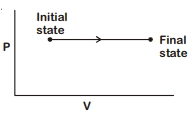
The $P-V$ diagram for an ideal gas in a piston cylinder assembly undergoing a thermodynamic process is shown in the figure. The process is
If solid will break under pressure greater than $13\  atm$ and that solid has a specific gravity of $4$ , what is the maximum height of a cylinder made from the solid that can be built at the earth's surface ? (Note: $1\ atm$ = $10^5\  Pa$ .) ......... $m$
On applying a stress of 20 × 108Nm-2, the length of a perfectly elastic wire is doubled. Its Young's modulus will be:
Heat required to convert one gram of ice at $0°C$ into steam at $100°C$ is $($given $L_{steam}$ $= 536\, cal/gm)$
Which one has the dimensions different from the remaining three
Two balls are projected from the same point simultaneously.First ball is projected vertically upwards and the second ball at an angle of projection $60^o$ to the ground level. Both the balls reach the ground simultaneously. The ratio of their velocities are
Block of mass $10 \,kg$ is moving on inclined plane with constant velocity $10 \,m / s$. The coefficient of kinetic friction between incline plane and block is ...........
If $L , C$ and $R$ denote the inductance, capacitance and resistance respectively, the dimensional formula for $C ^{2} LR$ is
The function $sin^2\,(\omega t)$ represents
In an electric circuit containing a battery, the charge (assumed positive) inside the battery:
  1. Always goes from the positive terminal to the negative terminal.
  2. May go from the positive terminal to the negative terminal.
  3. Always goes from the negative terminal to the positive terminal
  4. Does not move.