- Equal wavelengths have equal linear momenta.
- Equal energies have equal linear momenta.
- Equal frequencies have equal linear momenta.
- Equal linear momenta have equal wavelengths.
Explanation:
Two photons having equal linear momenta have equal wavelengths is correct. As in the rest of the options magnitude of momentum or energy can be same because energy and momentum are inversely proportional to wavelength. But the direction of propagation of the photons can be different.
Generate a complete, print-ready paper with questions like this in minutes — across 16+ boards, with answer keys.
All of the following statements are true except
|
(a) Conductance is the reciprocal of resistance and is measured in Siemens |
|
(b) Ohm's law is not applicable at very low and very high temperatures |
|
(c) Ohm's law is applicable to semiconductors |
|
(d) Ohm's law is not applicable to electron tubes, discharge tubes and electrolytes |
Angle of minimum deviation for a prism of refractive index 1.5 is equal to the angle of prism. The angle of prism is (cos 41° = 0.75)
|
(a) 62° |
(b) 41° |
(c) 82° |
(d) 31° |
The potential difference between point A & B is
|
(a) |
(b) |
(c) |
(d) 0 |
For a triode kilo ohm and
milli mho. If the load resistance is double of plate resistance, then the value of voltage gain will be
|
(a) 10 |
(b) 20 |
(c) 15 |
(d) 30 |
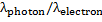
A photon and an electron have equal energy E.
is proportional to
|
(a) |
(b) 1/ |
|
(c) 1/E |
(d) Does not depend upon E |
For the production of characteristic
X-ray, the electron transition is
|
(a) n = 2 to n = 1 |
(b) n = 3 to n = 2 |
(c) n = 3 to n = 1 |
(d) n = 4 to n = 1 |
If the cathode–anode potential difference in an X-ray tube be 105 V, then the maximum energy of X-ray photon can be
| (a) 105 J | (b) 105 MeV | (c) 10–1 MeV | (d) 105 KeV |
In the nuclear reaction
what does X stand for
|
(a) An electron |
(b) A proton |
(c) A neutron |
(d) A neutrino |