Two resistors of resistance $R_1$ and $R_2$ having $R_1 > R_2$ are connected in parallel. For equivalent resistance $R$, the correct statements is
Easy


Download our appand get started for free
Experience the future of education. Simply download our apps or reach out to us for more information. Let's shape the future of learning together!No signup needed.*
Similar Questions
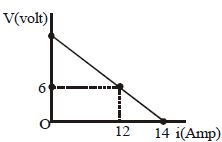
- 1$10\,Cells$, each of emf $'E'$ and internal resistance $'r'$, are connected in series to a variable external resistance. Figure shows the variation of terminal potential difference of their combination with the current drawn from the combination.$Emf$ of each cell is ............. $V$View Solution
- 2Two wires '$A$' and '$B$' of the same material have their lengths in the ratio $1 : 2$ and radii in the ratio $2 : 1$. The two wires are connected in parallel across a battery. The ratio of the heat produced in '$A$' to the heat produced in '$B$' for the same time isView Solution
- 3The resistance of a wire is $R$. If the length of the wire is doubled by stretching, then the new resistance will beView Solution
- 4Four equal resistance dissipated $5 \,W$ of power together when connected in series to a battery of negligible internal resistance. The total power dissipated in these resistance when connected in parallel across the same battery would be ........... $W$View Solution
- 5A material '$B$' has twice the specific resistance of '$A$'. A circular wire made of '$B$' has twice the diameter ofa wire made of '$A$'. then for the two wires to have the same resistance, the ratio $\frac{{{l_B}}}{{{l_A}}}$ of their respective lengths must beView Solution
- 6View SolutionElectric power is transmitted over long distances through conducting wires at high voltage because
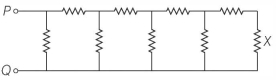
- 7Consider the circuit shown below where all resistors are $1 \,k \Omega$. If a current of magnitude $1 \,mA$ flows through the resistor marked $X$, the potential difference measured between points $P$ and $Q$ are ..............$V$View Solution
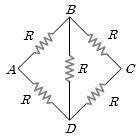
- 8Five equal resistances each of value $R$ are connected in a form shown alongside. The equivalent resistance of the networkView Solution
- 9Voltmeters $V_1$ and $V_2$ are connected in series across a $D.C.$ line. $V_1$ reads $80\, volts$ and has a per volt resistance of $200 \,\Omega$. $V_2$ has a total resistance of $32 \,kilo-ohms$. The line voltage is .............View Solution
- 10View SolutionAn electric heater kept in vacuum is heated continuously by passing electric current. Its temperature