An electric heater kept in vacuum is heated continuously by passing electric current. Its temperature
Easy


Download our appand get started for free
Experience the future of education. Simply download our apps or reach out to us for more information. Let's shape the future of learning together!No signup needed.*
Similar Questions
- 1Two wires '$A$' and '$B$' of the same material have their lengths in the ratio $1 : 2$ and radii in the ratio $2 : 1$. The two wires are connected in parallel across a battery. The ratio of the heat produced in '$A$' to the heat produced in '$B$' for the same time isView Solution
- 2If you are provided three resistances $2 \,\Omega$, $3 \,\Omega$ and $6 \,\Omega$. How will you connect them so as to obtain the equivalent resistance of $4 \,\Omega$View Solution
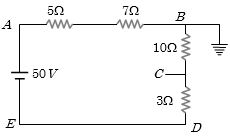
- 3In the circuit shown, the point ‘$B$’ is earthed. The potential at the point ‘$A$’ is ............. $V$View Solution
- 4Two resistances ${R_1}$ and ${R_2}$ when connected in series and parallel with $120\, V$ line, power consumed will be $25\, W$ and $100\, W$ respectively. Then the ratio of power consumed by ${R_1}$ to that consumed by ${R_2}$ will beView Solution
- 5View SolutionThe resistance of a conductor increases with
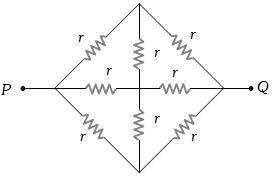
- 6The equivalent resistance between the points $P$ and $Q$ in the network given here is equal to ................ $\Omega$ (given $r = \frac{3}{2}\Omega $)View Solution
- 7A current of $1\, mA$ is flowing through a copper wire. How many electrons will pass a given point in one secondView Solution
- 8You are given three bulbs of $25$, $40$ and $60\, watt$. Which of them has lowest resistanceView Solution
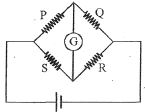
- 9Resistances are arranged in a cyclic order to form a balanced wheatstone bridge as shown in figure. Ratio of power consumed in the branches $P + Q$ and $R + S$ isView Solution
- 10A material '$B$' has twice the specific resistance of '$A$'. A circular wire made of '$B$' has twice the diameter ofa wire made of '$A$'. then for the two wires to have the same resistance, the ratio $\frac{{{l_B}}}{{{l_A}}}$ of their respective lengths must beView Solution