Two rods of same material and length have their electric resistance in ratio $1:2$. When both rods are dipped in water, the correct statement will be
Easy
Download our app for free and get started
(a) $R = \rho \frac{l}{A} \Rightarrow \frac{{{R_1}}}{{{R_2}}} = \frac{{{A_2}}}{{{A_1}}}(\rho ,L$ constant) $ \Rightarrow \frac{{{A_1}}}{{{A_2}}} = \frac{{{R_2}}}{{{R_1}}} = 2$
Now, when a body dipped in water, loss of weight $ = V{\sigma _L}g = AL{\sigma _L}g$
So, $\frac{{{{{\rm{(Loss \,of\, weight)}}}_{\rm{1}}}}}{{{{{\rm{(Loss\, of\, wight)}}}_{\rm{2}}}}} = \frac{{{A_1}}}{{{A_2}}} = 2;$ so $A$ has more loss of weight.

Download our appand get started for free
Experience the future of education. Simply download our apps or reach out to us for more information. Let's shape the future of learning together!No signup needed.*
Similar Questions
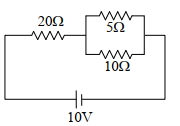
- 1The ratio of heat dissipated per second through the resistance $5 \Omega$ and $10 \Omega$ in the circuit given below is: :View Solution
- 2With a potentiometer null point were obtained at $140\, cm$ and $180\, cm$ with cells of $emf$ $1.1 \,V$ and one unknown $X\, volts$. Unknown $emf$ is .............. $V$View Solution
- 3View SolutionThe brightness of a bulb will be reduced, if a resistance is connected in
- 4The balancing length for a cell is $560 \;\mathrm{cm}$ in a potentiometer experiment. When an external resistance of $10 \;\Omega$ is connected in parallel to the cell, the balancing length changes by $60\; \mathrm{cm} .$ If the internal resistance of the cell is $\frac{\mathrm{N}}{10} \;\Omega,$ where $\mathrm{N}$ is an integer then value of $\mathrm{N}$ isView Solution
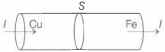
- 5Two rods of copper and iron with the same cross-sectional area are joined at $S$ and a steady current $I$ flows through the rods as shown in the figure. Choose the most appropriate representation of charges accumulated near the junction $S$.View Solution
- 6View SolutionTwo wires of the same material are given. The first wire is twice as long as the second and has twice the diameter of the second. The resistance of the first will be
- 7An electron (charge $= 1.6 × 10^{-19}$ coulomb) is moving in a circle of radius $5.1 × 10^{-11}\,m$ at a frequency of $6.8 × 10^{15} $ revolutions/sec. The equivalent current is approximatelyView Solution
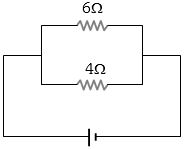
- 8In the circuit shown below, the power developed in the $6$ $\Omega$ resistor is $6\, watt$. The power in watts developed in the $4$ $ \Omega$ resistor isView Solution
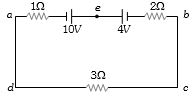
- 9View SolutionThe magnitude and direction of the current in the circuit shown will be
- 10A wire of $1 \,\Omega$ has a length of $1\, m$. It is stetched till its length increases by $25\, \%$. The percentage change in resistance to the neartest integer is .....$\%$View Solution