Two simple pendulums of lengths $1.44 \,m$ and $1\, m$ start swinging together. After how many vibrations will they again start swinging together
Medium
Download our app for free and get started
(b) $n \propto \frac{1}{{\sqrt l }}$==> $\frac{{{n_2}}}{{{n_1}}}$$ = \sqrt {\frac{{1.44}}{1}} = \frac{{1.2}}{1}$==> ${n_2} = 1.2\,{n_1}$
For $n2$ be integer minimum value of $n1$ should be $5$ and then $n2 = 6$ i.e., after $6 $ oscillations of smaller pendulum both will be in phase.

Download our appand get started for free
Experience the future of education. Simply download our apps or reach out to us for more information. Let's shape the future of learning together!No signup needed.*
Similar Questions
- 1A simple pendulum oscillating in air has period $T.$ The bob of the pendulum is completely immersed in a non-viscous liquid. The density of the liquid is $\frac {1}{16}$ of the material of the bob. If the bob is inside liquid all the time, its period of oscillation in this liquid isView Solution
- 2A body is moving in a room with a velocity of $20\, m / s$ perpendicular to the two walls separated by $5$ meters. There is no friction and the collisions with the walls are elastic. The motion of the body isView Solution
- 3View SolutionThe total energy of a particle executing simple harmonic motion is
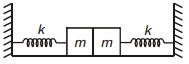
- 4View SolutionAn assembly of identical spring-mass systems is placed on a smooth horizontal surface as shown. At this instant, the springs are relaxed. The left mass is displaced to the/left and theiright mass is displaced to the right by same distance and released. The resulting collision is elastic. The time period of the oscillations of system is
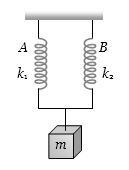
- 5A mass $m$ is suspended by means of two coiled spring which have the same length in unstretched condition as in figure. Their force constant are $k_1$ and $k_2$ respectively. When set into vertical vibrations, the period will beView Solution
- 6A pendulum suspended from the ceiling of a train has a period $T$ when the train is at rest. When the train travels same distance per unit time, the period of oscillation isView Solution
- 7View SolutionTwo oscillating systems; a simple pendulum and a vertical spring-mass-system have same time period of motion on the surface of the Earth. If both are taken to the moon, then-
- 8$Assertion :$ In simple harmonic motion, the velocity is maximum when the acceleration is minimum.View Solution
$Reason :$ Displacement and velocity of $S.H.M.$ differ in phase by $\frac{\pi }{2}$ - 9A spring is stretched by $5 \,\mathrm{~cm}$ by a force $10 \,\mathrm{~N}$. The time period of the oscillations when a mass of $2 \,\mathrm{~kg}$ is suspended by it is :(in $s$)View Solution
- 10A particle is executing a simple harmonic motion. Its maximum acceleration is $\alpha$ and maximum velocity is $\beta$. Then, its time period of vibration will beView Solution