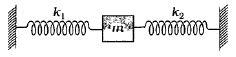
Two springs, of force constants $k_1$ and $k_2$ are connected to a mass $m$ as shown. The frequency of oscillation of the mass is $f$ If both $k_1$ and $k_2$ are made four times their original values, the frequency of oscillation becomes
AIEEE 2007, Medium
Download our app for free and get started
The two springs are in parallel.
$f=\frac{1}{2 \pi} \sqrt{\frac{K_{1}+K_{2}}{m}}$ $...(i)$
$f^{\prime}=\frac{1}{2 \pi} \sqrt{\frac{4 K_{1}+4 K_{2}}{m}}$
$=\frac{1}{2 \pi} \sqrt{\frac{4\left(K_{1}+4 K_{2}\right)}{m}}=2\left(\frac{1}{2 \pi} \sqrt{\frac{K_{1}+K_{2}}{m}}\right)$
$=2 f \quad$ from eqn. $(i)$
$f=\frac{1}{2 \pi} \sqrt{\frac{K_{1}+K_{2}}{m}}$ $...(i)$
$f^{\prime}=\frac{1}{2 \pi} \sqrt{\frac{4 K_{1}+4 K_{2}}{m}}$
$=\frac{1}{2 \pi} \sqrt{\frac{4\left(K_{1}+4 K_{2}\right)}{m}}=2\left(\frac{1}{2 \pi} \sqrt{\frac{K_{1}+K_{2}}{m}}\right)$
$=2 f \quad$ from eqn. $(i)$

Download our appand get started for free
Experience the future of education. Simply download our apps or reach out to us for more information. Let's shape the future of learning together!No signup needed.*
Similar Questions
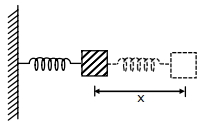
- 1The motion of a mass on a spring, with spring constant ${K}$ is as shown in figure. The equation of motion is given by $x(t)= A sin \omega t+ Bcos\omega t$ with $\omega=\sqrt{\frac{K}{m}}$ Suppose that at time $t=0$, the position of mass is $x(0)$ and velocity $v(0)$, then its displacement can also be represented as $x(t)=C \cos (\omega t-\phi)$, where $C$ and $\phi$ areView Solution
- 2A rectangular block of mass $m$ and area of cross-section $A$ floats in a liquid of density $\rho $. If it is given a small vertical displacement from equilibrium it undergoes with a time period $T,$ thenView Solution
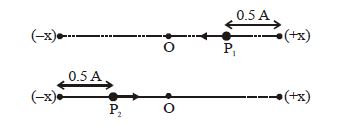
- 3Two bodies performing $S.H.M.$ have same amplitude and frequency. Their phases at a certain instant are as shown in the figure. The phase difference between them isView Solution
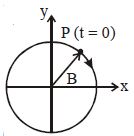
- 4Figure shows the circular motion of a particle. The radius of the circle, the period, sense of revolution and the initial position are indicated on the figure. The simple harmonic motion of the $x-$ projection of the radius vector of the rotating particle $P$ isView Solution
- 5A particle is subjected to two mutually perpendicular simple harmonic motions such that its $x$ and $y$ coordinates are given by ?View Solution
$ x = 2 \sin \omega t \,;$ $ y = 2 \sin \left( {\omega t + \frac{\pi }{4}} \right)$
The path of the particle will be :
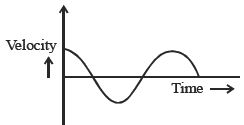
- 6View SolutionThe graph in figure represents
- 7A mass $M$ is suspended from a spring of negligible mass. The spring is pulled a little and then released so that the mass executes simple harmonic oscillations with a time period $T$. If the mass is increased by m then the time period becomes $\left( {\frac{5}{4}T} \right)$. The ratio of $\frac{m}{{M}}$ isView Solution
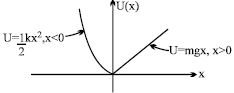
- 8A particle of mass $m$ moves in the potential energy $U$ shown above. The period of the motion when the particle has total energy $E$ isView Solution
- 9If the time period of a two meter long simple pendulum is $2\, s$, the acceleration due to gravity at the place where pendulum is executing $S.H.M.$ isView Solution
- 10A spring whose unstretched length is $\ell $ has a force constant $k$. The spring is cut into two pieces of unstretched lengths $\ell_1$ and $\ell_2$ where, $\ell_1 = n\ell_2$ and $n$ is an integer. The ratio $k_1/k_2$ of the corresponding force constants, $k_1$ and $k_2$ will beView Solution