Question
Two statements are given-one labelled Assertion (A) and the other labelled Reason (R). Select the correct answer to these questions from the codes (a), (b), (c) and (d) as given below.
  1. Both A and R are true and R is the correct explanation of A.
  2. Both A and R are true but R is NOT the correct explanation of A.
  3. A is true but R is false.
  4. A is false and R is also false.
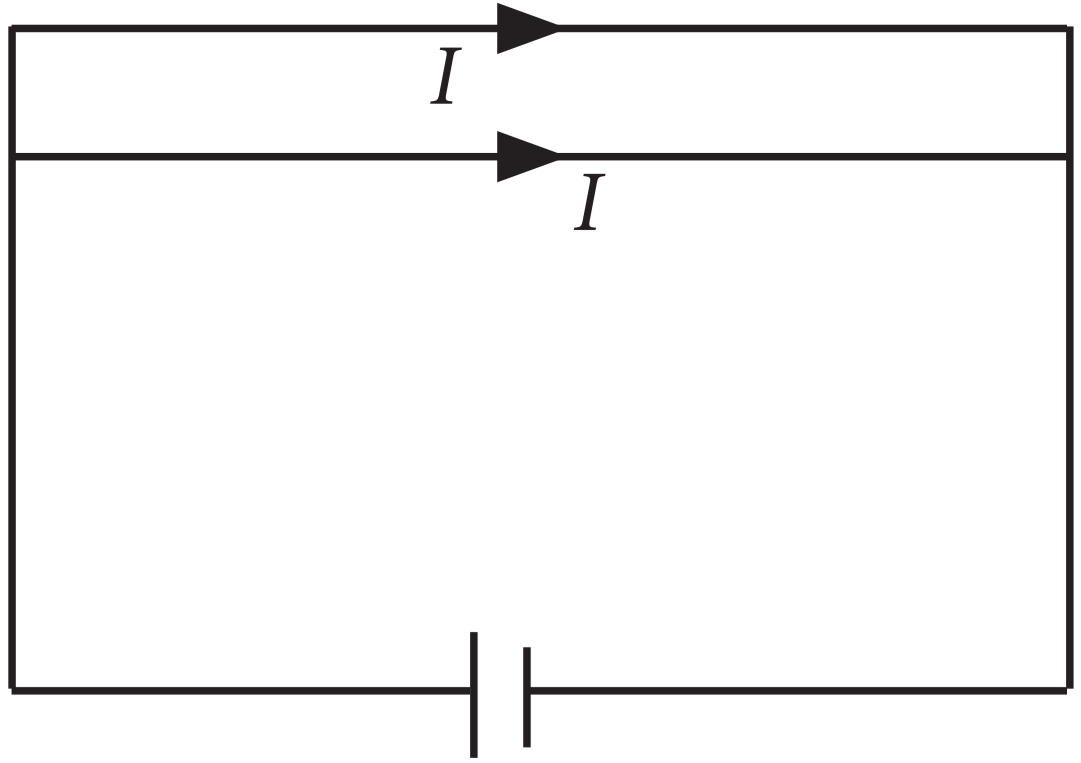
Assertion (A): When two long parallel wires, hanging freely are connected in parallel to a battery, they come closer to each other.
Reason (R): Wires carrying current in opposite direction repel each other.
Answer

  1. Both A and Rare true but R is NOT the correct explanation of A.

Explanation:

The wires are parallel to each other but the direction of current in it is in same direction so they attract each other. If the current in the wires is in opposite direction then wires repel each other. When the currents are in opposite directions, the magnetic forces are reversed and the wires repels each other.

Need a full question paper?

Generate a complete, print-ready paper with questions like this in minutes — across 16+ boards, with answer keys.

Start Generating Free

Similar questions

For question two statements are given$-$one labelled Assertion $(A)$ and the other labelled Reason $(R).$ Select the correct answer to these questions front the codes $(a), (b), (c)$ and $(d)$ as given below.
Assertion $(A):$ As work function of a material increases by some mechanism, it requires greater energy to excite the electrons from its surface.
Reason $(R):$ A plot of stopping potential $(V,)$ versus frequency $(\upsilon)$ for different metals, has greater slope for metals with greater work functions.
Assertion (A): If a proton and electron are moving with same velocity, then wavelength of de-Broglie wave associated with electron is longer than that associated with proton.
Reason (R): The wavelength of de-Broglie wave associated with a moving particle is inversely proportional to its mass.
For two statements are given-one labelled Assertion (A) and the other labelled Reason (R). Select the correct answer to these questions from the codes (a), (b), (c) and (d) as given below.
  1. Both A and R are true, and R is the correct explanation of A.
  2. Both A and R are true, but R is not the correct explanation of A.
  3. A is true, but R is false.
  4. A is false, and R is also false.
Assertion (A): Positive charge always moves from a higher potential point to a lower potential point.
Reason (R): Electric potential is a vector quantity.
For question two statements are given-one labelled Assertion (A) and the other labelled Reason (R). Select the correct answer to these questions front the codes (a), (b), (c) and (d) as given below.
  1. Both A and R are true and R is the correct explanation of A.
  2. Both A and R are true but R is NOT the correct explanation of A.
  3. A is true but R is false.
  4. A is false and R is also false.
Assertion (A): The threshold frequency of photoelectric effect supports the particle nature of light.
Reason (R): If frequency of incident light is less than the threshold frequency, electrons are not emitted from metal surface.
Two statements are given-one labelled Assertion (A) and the other labelled Reason (R). Select the correct answer to these questions from the codes (a), (b), (c) and (d) as given below.
  1. Both A and R are true and R is the correct explanation of A.
  2. Both A and R are true but R is not the correct explanation of A.
  3. A is true but R is false.
  4. A is false and R is also false.
Assertion: Infrared waves sometimes referred as heat waves.
Reason: Infrared waves heat up the earth surface.
For two statements are given-one labelled Assertion (A) and the other labelled Reason (R). Select the correct answer to these questions from the codes (a), (b), (c) and (d) as given below.
  1. Both A and R are true, and R is the correct explanation of A.
  2. Both A and R are true, but R is not the correct explanation of A.
  3. A is true, but R is false.
  4. A is false, and R is also false.
Assertion (A): If the distance between parallel pates of a capacitor is halved and dielectric constant is made three times, then the capacitance becomes six times.
Reason (R): Capacitance of the capacitor does not depend upon the nature of the material of the plates.
For question two statements are given-one labelled Assertion (A) and the other labelled Reason (R). Select the correct answer to these questions from the codes (a), (b), (c) and (d) as given below.
  1. Both A and R are true and R is the correct explanation of A.
  2. Both A and R are true but R is NOT the correct explanation of A.
  3. A is true but R is false.
  4. A is false and R is also false.
Assertion (A): When a light wave travels from a rarer to a denser medium, it loses speed. TI1e reduction in speed imply a reduction in energy carried by the light wave.
Reason (R): The energy of a wave is proportional to velocity of wave.
Two statements are given-one labelled Assertion (A) and the other labelled Reason (R). Select the correct answer to these questions from the codes (a), (b), (c) and (d) as given below.
  1. Both A and R are true and R is the correct explanation of A.
  2. Both A and R are true but R is NOT the correct explanation of A.
  3. A is true but R is false.
  4. A is false and R is also false.
Assertion (A): When the observation point lies along the length of the current element, magnetic field is zero.
Reason (R): Magnetic field close to current element is zero.
Two statements are given-one labelled Assertion (A) and the other labelled Reason (R). Select the correct answer to these questions from the codes (a), (b), (c) and (d) as given below.
  1. Both A and R are true and R is the correct explanation of A.
  2. Both A and R are true but R is not the correct explanation of A.
  3. A is true but R is false.
  4. A is false and R is also false.
Assertion: By increasing the diameter of the objective of telescope, we can increase its range.
Reason: The range of a telescope tells us how far away a star of some standard brightness can be spotted by telescope.
For question two statements are given-one labelled Assertion (A) and the other labelled Reason (R). Select the correct answer to these questions front the codes (a), (b), (c) and (d) as given below.
  1. Both A and R are true and R is the correct explanation of A.
  2. Both A and R are true but R is NOT the correct explanation of A.
  3. A is true but R is false.
  4. A is false and R is also false.
Assertion (A): On increasing the frequency of light, larger number of photoelectrons are emitted.
Reason (R): The number of electrons emitted is directly proportional to the intensity of incident light.