Two wires $A$ and $B$ of the same material, having radii in the ratio $1: 2$ carry currents in the ratio $4: 1$. The ratio of drift speed of electrons in $A$ and $B$ is .......
Medium


Download our appand get started for free
Experience the future of education. Simply download our apps or reach out to us for more information. Let's shape the future of learning together!No signup needed.*
Similar Questions
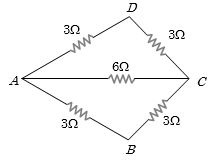
- 1The effective resistance between the points $A$ and $B$ in the figure is ............. $\Omega$View Solution
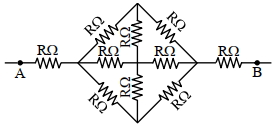
- 2The effective resistance between $A$ and $B$, if resistance of each resistor is $R$, will beView Solution
- 3View SolutionWhat is immaterial for an electric fuse wire
- 4${\sigma _1}$ and ${\sigma _2}$ are the electrical conductivities of $Ge $ and $Na$ respectively. If these substances are heated, thenView Solution
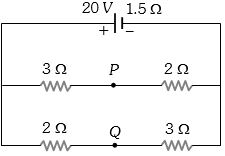
- 5If in the circuit shown below, the internal resistance of the battery is $1.5$ $\Omega$ and $V_P$ and $V_Q$ are the potentials at $P$ and $Q$ respectively, what is the potential difference between the points $P$ and $Q$View Solution
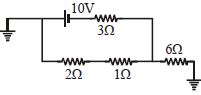
- 6Find current in $6\,\Omega $ resistanceView Solution
- 7In a potentiometer experiment two cells of $e.m.f.$ $E_1$ and $E_2$ are used in series and in conjunction and the balancing length is found to be $58\, cm$ of the wire. If the polarity of $E_2$ is reversed, then the balancing length becomes $29\, cm$. The ratio $\frac{{{E_1}}}{{{E_2}}}$ of the $e.m.f.$ of the two cells isView Solution
- 8View SolutionPotential gradient is defined as
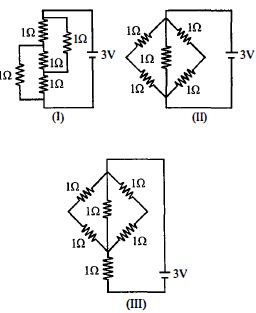
- 9The figure shows three circuits $I, II$ and $III$ which are connected to a $3\,V$ battery. If the powers dissipated by the configurations $I, II$ and $III$ are $P_1 , P_2$ and $P_3$ respectively, thenView Solution
- 10An electric fan and a heater are marked as $100\, watt$, $220\, volt$ and $1000\, watt$, $220\, volt$ respectively. The resistance of the heater isView Solution