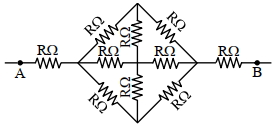
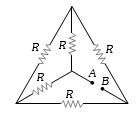
The effective resistance between $A$ and $B$, if resistance of each resistor is $R$, will be
JEE MAIN 2024, Diffcult
Download our app for free and get started
From symmetry we can remove two middle resistance.
New circuit is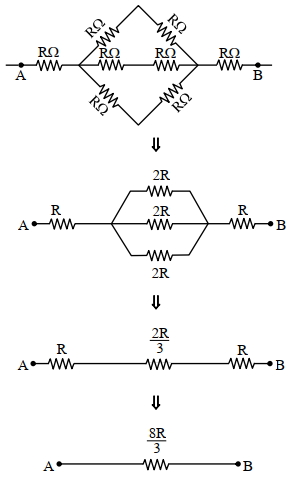

Download our appand get started for free
Experience the future of education. Simply download our apps or reach out to us for more information. Let's shape the future of learning together!No signup needed.*
Similar Questions
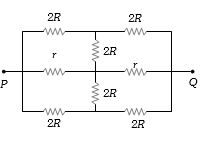
- 1The effective resistance between points $P$ and $Q$ of the electrical circuit shown in the figure isView Solution
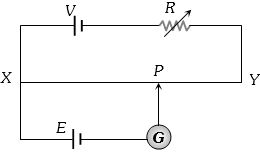
- 2A potentiometer circuit shown in the figure is set up to measure $e.m.f.$ of a cell $E$. As the point $P$ moves from $X$ to $Y$ the galvanometer $G$ shows deflection always in one direction, but the deflection decreases continuously until $Y$ is reached. In order to obtain balance point between $X$ and $Y$ it is necessary toView Solution
- 3Each of the resistance in the network shown in fig. is equal to $R$. The resistance between the terminals $A$ and $B$ isView Solution
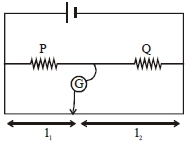
- 4The meter bridge shown is in balanced position with $\frac{\mathrm{P}}{\mathrm{Q}}=\frac{\mathrm{l}_{1}}{\mathrm{l}_{2}}$. If we now litterchange the positions of gavanometer and cell, will the bridge work? If yes, what will be balance condition?View Solution
- 5An electrical bulb rated $220\,V , 100\,W$, is connected in series with another bulb rated $220\,V$, $60\,W$.If the voltage across combination is $220\,V$, the power consumed by the $100\,W$ bulb will be about $........... W$View Solution
- 6In order to increase the resistance of a given wire of uniform cross section to four times its value, a fraction of its length is stretched uniformly till the full length of the wire becomes $\frac{3}{2}$ times the original length what is the value of this fraction?View Solution
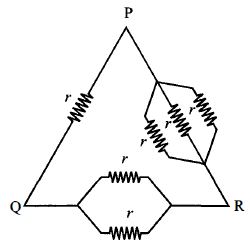
- 7Six equal resistances are connected between points $P, Q$ and $R$ as shown in figure. Then net resistance will be maximum betweenView Solution
- 8The electric current through a wire varies with time as $I=I_0+\beta t$. where $I_0=20 \mathrm{~A}$ and $\beta=3 \mathrm{~A} / \mathrm{s}$. The amount of electric charge crossed through a section of the wire in $20 \mathrm{~s}$ is :View Solution
- 9First, a set of ${n}$ equal resistors of $10\; \Omega$ each are connected in series to a battery of emf $20\; {V}$ and internal resistance $10\; \Omega .$ A current $I$ is observed to flow. Then, the $n$ resistors are connected in parallel to the same battery. It is observed that the current is increased $20$ times, then the value of $n$ is .... .View Solution
- 10A heating element has a resistance of $100\,\Omega $ at room temperature. When it is connected to a supply of $220\,V,$ a steady current of $2\,A$ passes in it and temperature is $500\,^oC$ more than room temperature. What is the temperature coefficient resistance of the heating element?View Solution