Two wires of same material have length $L$ and $2L $ and cross-sectional areas $4A$ and $A$ respectively. The ratio of their specific resistance would be
Easy


Download our appand get started for free
Experience the future of education. Simply download our apps or reach out to us for more information. Let's shape the future of learning together!No signup needed.*
Similar Questions
- 1$32$ cells, each of $emf$ $3V$, are connected in series and kept in a box. Externally, the combination shows an $emf$ of $84\, V$. The number of cells reversed in the combination isView Solution
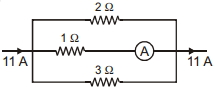
- 2The ammeter reading in the circuit below is .............. $A$View Solution
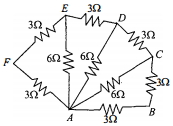
- 3Six resistors of $3 \;\Omega$ each are connected along the sides of a hexagon and three resistors of $6\; \Omega$ each are connected along $A C, A D$ and $A E$ as shown in the figure. The equivalent resistance between $A$ and $B$ is equal toView Solution
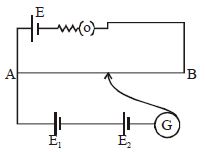
- 4In given arrangement $E_1 = 5\, volts$ $E_2 = 7\, volt$ balancing length is $6\,m$ if terminals of $E_2$ are reversed then new balancing length will beView Solution
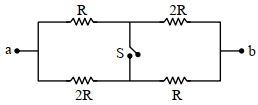
- 5The ratio of the equivalent resistance of the network (shown in figure) between the points $a$ and ${b}$ when switch is open and switch is closed is ${x}: 8 .$ The value of ${x}$ is ..... .View Solution
- 6View SolutionTwo resistors having equal resistances are joined in series and a current is passed through the combination. Neglect any variation in resistance as the temperature changes. In a given time interval
- 7Five cells each of emf $E$ and internal resistance $r$ are connected in series. Due to oversight one cell is connected wrongly. The equivalent internal resistance of the combination is ........... $r$View Solution
- 8A copper wire of length $1\, m$ and radius $1\, mm$ is joined in series with an iron wire of length $2\, m$ and radius $3\, mm$ and a current is passed through the wires. The ratio of the current density in the copper and iron wires isView Solution
- 9By a cell a current of $0.9\, A$ flows through $2\, ohm$ resistor and $0.3\,A$ through $7\, ohm$ resistor. The internal resistance of the cell is ............ $\Omega$View Solution
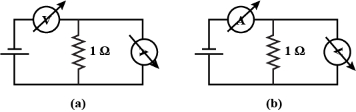
- 10A student uses the resistance of a known resistor $(1 \,\Omega)$ to calibrate a voltmeter and an ammeter using the circuits shown below. The student measures the ratio of the voltage to current to be $1 \times 10^3 \,\Omega$ in circuit $(a)$ and $0.999 \,\Omega$ in circuit $(b)$. From these measurements, the resistance (in $\Omega$ ) of the voltmeter and ammeter are found to be close toView Solution