Two wires of same metal have the same length but their cross-sections are in the ratio $3:1$. They are joined in series. The resistance of the thicker wire is $10\,\Omega $. The total resistance of the combination will be ............. $\Omega$
AIPMT 1995,AIIMS 2012, Medium
Download our app for free and get started
For same material and same length
$\frac{{{R_2}}}{{{R_1}}} = \frac{{{A_1}}}{{{A_2}}} = \frac{3}{2}$ $ \Rightarrow $ ${R_2} = 3{R_1}$
Resistance of thick wire ${R_1} = 10\,\Omega $
Resistance of thin wire ${R_2} = 30\,\Omega $
Total resistance in series $ = 10 + 30 = 40\,\Omega$

Download our appand get started for free
Experience the future of education. Simply download our apps or reach out to us for more information. Let's shape the future of learning together!No signup needed.*
Similar Questions
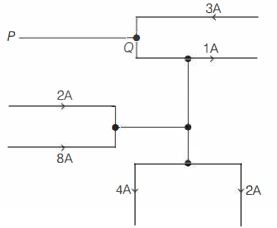
- 1Figure below shows a portion of an electric circuit with the currents in amperes and their directions. The magnitude and direction of the current in the portion $P Q$ isView Solution
- 2The length of a metallic wire is increased by $20 \%$ and its area of cross section is reduced by $4 \%$. The percentage change in resistance of the metallic wire is $.......$View Solution
- 3A wire when connected to $220\,V$ mains supply has power dissipation ${P_1}$. Now the wire is cut into two equal pieces which are connected in parallel to the same supply. Power dissipation in this case is ${P_2}$. Then ${P_2}:{P_1}$ isView Solution
- 4When a current of $2\, A$ flows in a battery from negative to positive terminal, the potential difference across it is $12\, V$. If a current of $3 \,A$ flows in the opposite direction potential difference across the terminals of the battery is $15\, V$, the $emf$ of the battery is ................ $\mathrm{V}$View Solution
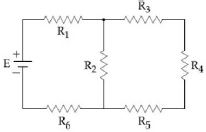
- 5In the figure shown, what is the current (in Ampere) drawn from the battery ? You are given $R_1 = 15\,\Omega $$,R _2 = 10\,\Omega ,$$ R_3 = 20\,\Omega ,$$ R_4 = 5\,\Omega ,$$R_5 = 25\,\Omega ,$$R_6 = 30\,\Omega , $$E = 15\,V$View Solution
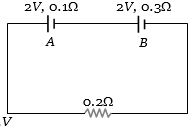
- 6The internal resistances of two cells shown are $0.1\,\Omega $ and $0.3\,\Omega $. If $R = 0.2\,\Omega $, the potential difference across the cellView Solution
- 7View SolutionWe are able to obtain fairly large currents in a conductor because
- 8View SolutionWatt-hour meter measures
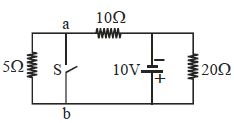
- 9In the circuit shown below, the current that flows from $a$ to $b$ when the switch $S$ is closed ............... $A$View Solution
- 10The resistance of platinum wire at $0^{\circ}\,C$ is $2\,\Omega$ and $6.8\,\Omega$ at $80^{\circ} \,C$. The temperature coefficient of resistance of the wire is :View Solution