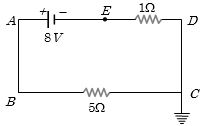
In the given circuit, the potential of the point $E$ is
Medium


Download our appand get started for free
Experience the future of education. Simply download our apps or reach out to us for more information. Let's shape the future of learning together!No signup needed.*
Similar Questions
- 1Three identical cells are connected in parallel across $A B$. Net emf across $A B$ is .......... $V$View Solution
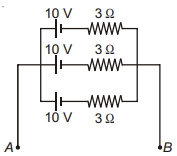
- 2What is the equivalent resistance of the circuit ............. $\Omega$View Solution
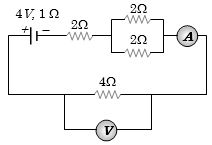
- 3Four identical cells each having an electromotive force $(e.m.f.)$ of $12\,V$, are connected in parallel. The resultant electromotive force $(e.m.f.)$ of the combination is .............. $V$View Solution
- 4A resistor dissipates $192\, {J}$ of energy in $1\, {s}$ when a current of $4\, {A}$ is passed through it. Now, when the current is doubled, the amount of thermal energy dissipated in $5 \,{s}$ in $.....\,J.$View Solution
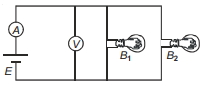
- 5Two identical bulbs are connected in parallel across an ideal source of emf $E$. The ammeter $A$ and voltmeter $V$ are ideal. If bulb $B_2$ gets fused, thenView Solution
- 6A wire has a resistance of $12\, ohm$. It is bent in the form of equilateral triangle. The effective resistance between any two corners of the triangle isView Solution
- 7The current in a wire varies with time according to relation $I = 4 + 2t$. The quantity of charge which has passed through a crosssectionn of the wire during the time $t = 2\, s$ to $t = 6\, s$ will be .............. $\mathrm{C}$View Solution
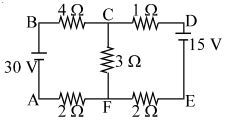
- 8The figure shows a network of five resistances and two batteries The current through the $30\,V$ battery is ............... $A$View Solution
- 9The electric resistance of a certain wire of iron is $R$. If its length and radius are both doubled, thenView Solution
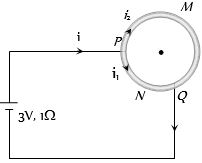
- 10A wire of resistance $10$ $\Omega$ is bent to form a circle. $P$ and $Q$ are points on the circumference of the circle dividing it into a quadrant and are connected to a Battery of $3\, V$ and internal resistance $1$ $\Omega$ as shown in the figure. The currents in the two parts of the circle areView Solution