MCQ
What is immaterial for an electric fuse wire
  • A
    Its specific resistance
  • B
    Its radius
  • Its length
  • D
    Current flowing through it

Answer

Correct option: C.
Its length
c
(c) Length is immaterial for an electric fuse wire.

Need a full question paper?

Generate a complete, print-ready paper with questions like this in minutes — across 16+ boards, with answer keys.

Start Generating Free

Similar questions

In a common base circuit of a transistor, the amplification factor is $0.95.$ The base current when the emitter current is $2\,mA,$ is ....$mA$
An astronomical refracting telescope is being used by an observer to observe planets in normal adjustment. The focal lengths of the objective and eye piece used in the construction of the telescope are $20\,m$ and $2\,cm$ respectively. Consider the following statements about the telescope :

$(a)$ The distance between the objective and eye piece is $20.02\; m$

$(b)$ The magnification of the telescope is $1000$

$(c)$ The image of the planet is erect and diminished

$(d)$ The aperture of eye piece is smaller than that of objective

The correct statements are :
$A$ ray of light is incident on $a$ parallel slab of thickness $t$ and refractive index $n$. If the angle of incidence $\theta$ is small than the displacement in the incident and emergent ray will be :
An electron of mass $m$ and charge $e$ is accelerated from rest through a potential difference $V$ in vacuum. Its final velocity will be
An electron beam is moving between two parallel plates having electric field $1.125 \times 10^{-6} \mathrm{~N} / \mathrm{m}$. A magnetic field $3 \times 10^{-10} \mathrm{~T}$ is also applied so that beam of electrons do not deflect. The velocity of the electron is
The energy of electromagnetic wave in vacuum is given by the relation
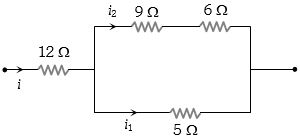
In the following circuit, $5$ $\Omega$ resistor develops $45$ $J/s$ due to current flowing through it. The power developed per second across $12$ $\Omega$ resistor is ............. $W$
The maximum velocity of an electron emitted by light of wavelength $\lambda $ incident on the surface of a metal of work function $\phi ,$ is

Where $h =$ Planck's constant, $m =$ mass of electron and $c =$ speed of light.

The power (in diopters) of an equiconvex lens with radii of curvature of $10\, cm$ and refractive index of $1.6$ is
A proton moving with a constant velocity passes through a region of space without any change in its velocity. If $\vec{E}$ and $\vec{B}$ represent the electric and magnetic fields respectively, then the region of space may have :

($A$) $\mathrm{E}=0, \mathrm{~B}=0$

($B$) $\mathrm{E}=0, \mathrm{~B} \neq 0$

($C$) $\mathrm{E} \neq 0, \mathrm{~B}=0$

($D$) $\mathrm{E} \neq 0, \mathrm{~B} \neq 0$

Choose the most appropriate answer from the options given below :